

Among devout believers and culture enthusiasts

Stage 2: Pilgrimage on both sides of Rome's ancient city walls


The Holy Year 2025 is still underway.
I'm joining the pilgrimage. Three more churches are on my route, papal basilicas, but without the Porta Santa like the three large churches on my first stage and San Pietro on my third stage.
Why seven pilgrimage churches? Initially, in the first Holy Year of 1300, only St. Peter's and St. Paul's, the basilicas of the two apostles, were mandatory for penitent pilgrims. Later, the other two principal churches were added: St. John Lateran and St. Mary Major. Philip Neri increased the number to seven in the 16th century during the Counter-Reformation with three more churches, each significant in its own way as a repository for relics or martyrs.


The expansion of the pilgrimage route coincided with a relaxation of the rules for pilgrims seeking indulgences. In 1350, the route had to be completed within 24 hours. In the founding year of 1300, pilgrims from outside Rome were required to visit St. Peter and St. Paul for 30 days, and Romans for 15 days; later, such time restrictions were lifted. And for 500 years now, telepathic prayers have been sufficient to achieve the pilgrimage's goal: remission of both material and spiritual debts.
Churchmen's mercy wasn't always the reason for relaxed pilgrim regulations. Rather, it was their pragmatic intelligence. Plague and other epidemics repeatedly raged in Rome during Holy Years, brought in by pilgrims from abroad, exacerbated by overcrowding and the city's appalling sanitary conditions. The high number of pilgrims, 200,000 in the first Holy Year, could thus plummet, drying up the coffers of the clergy and the city. Only clever public relations could help, as in 1475: crowned heads from all over Europe were invited to Rome for the Jubilee Year, and the news was widely disseminated using Gutenberg's printing press.
Seven pilgrimage churches represent a parity with the seven hills of Rome, as well as the seven works of mercy: e.g. welcoming and feeding strangers and enduring injustice. And all seven churches could be reached on foot in a single day. A challenging pilgrimage, but doable. Today, freedom of travel and transportation prevails. With my comfortably paced, three-stage pilgrimage, I'm right on trend.
Station 4: Basilica di Santa Croce in Gerusalemme
No, not a pilgrimage to the cradle of Christianity, which, given the current raging military conflict between Israelis and Palestinians, doesn't seem particularly appropriate. Rather, it's the name of a reliquary church built on the foundations of an imperial palace complex. Emperor Constantine, after founding the four major churches of Rome, moved to the eastern Roman Empire in 324. His mother, Helena, left after him in 325, but on a pilgrimage to Jerusalem driven by archaeological interest. From excavations there, she brought back Passion relics: wood fragments from the True Cross, the inscription INRI (Jesus of Nazareth, King of the Jews), fragments of the Crown of Thorns, earth and nails from Calvary, the hill of the crucifixion, and a copy of the Shroud of Turin. Reason enough for today's curiosity, veneration, and pilgrimage. Even if the authenticity is partly disputed and radiocarbon dating suggests a medieval origin for some of the relics.

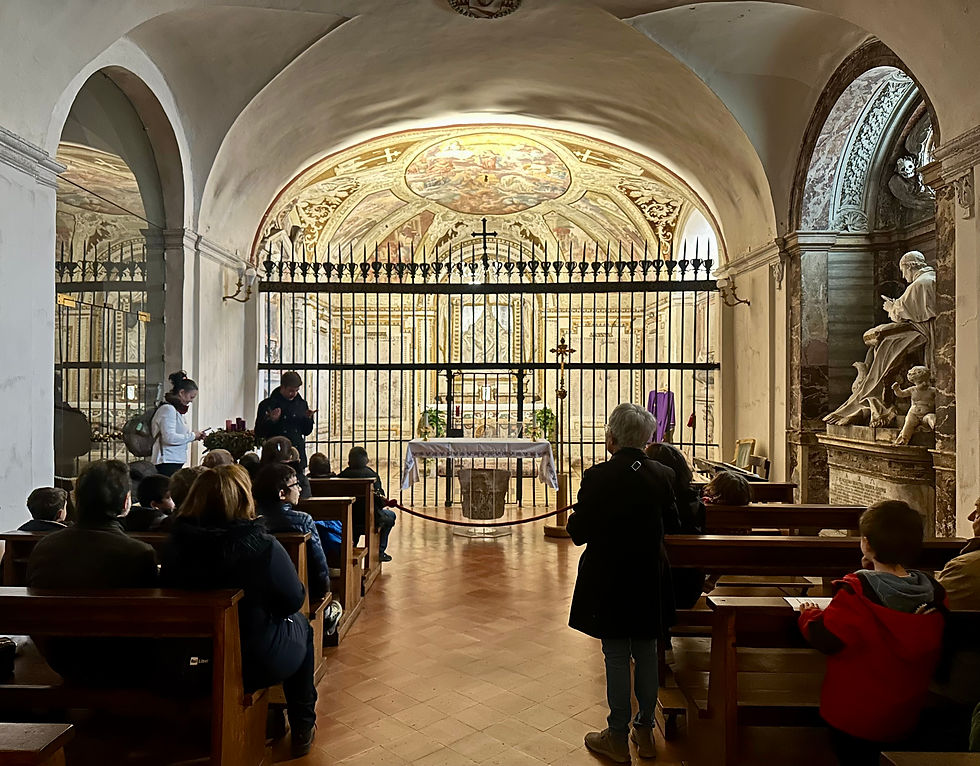
Station 5: Basilica di San Sebastiano alle Catacombe

Next to the basilica, a path leads down into the Catacombs of San Sebastiano. This underground burial complex features a structured tunnel system on four levels. The burial chambers, dating back to pagan Roman times, also housed Christians from the 2nd century onward, including Sebastian, an officer in the imperial guard. His early conversion to Christianity triggered Emperor Diocletian's harsh punishments, staged as a public deterrent in the Circus Maximus. In this densely packed arena, Sebastian's agonizing execution by clubbing was a public spectacle. Compassionate Christians recovered his mutilated body and reinterred it in the underground tomb outside the city walls. In the early 4th century, the catacombs were named after him as a martyr and saint, as was the basilica built there, the first pilgrimage church outside the walls of Rome.
In the reliquary chapel within the church, Sebastian's torture instruments are on display. According to legend, the supposed footprints of Christ were created when Peter, fleeing persecutors, was leaving Rome. Jesus appeared to him on the Appian Way and, in response to his question, "Quo vadis?" ("Where are you going?"), replied, "I am going to Rome to be crucified again." Peter took this answer as his cue to do the same. His martyrdom was thus sealed. Such devotion to the faith still impresses pilgrims in 2025.
The Chapel of St. Sebastian houses his remains and his reclining statue. The last Bernini, a marble Christ from 1679, greets pilgrims at the entrance. Having resurfaced in 2001 after a long and dubious journey, the bust now stands behind glass, only weakly secured.

Of course, there are still dedicated pilgrims who make their way to Rome along the Francigena, the medieval Frankish Way stretching 2,000 km from England through France and Switzerland. But even here, on foot, people are sometimes exchanging their walking for the tire marks of two or four wheels. By land or air.
And the overland route to San Sebastiano is quite something! Situated on the Via Appia Antica – today a thoroughfare connecting Rome city and the surrounding countryside – the basilica forms part of the world's longest open-air museum walk, lined with ancient patrician houses and mausoleums on both sides, interspersed with more recent private residences. On this road, the church is a pilgrimage destination that demands a certain amount of skill.

I park just before the car-free section of the Via Appia Antica And I place my foot on basalt. It's ancient. And it's been there since 312 BC. A sturdy cobblestone pavement on the transport route between Rome and Capua (150 km south), later extending 540 km further to Brindisi in the heel of the Italian boot, at that time the most important transshipment port for goods from the Orient. The construction order and street name were given by Consul Appius Claudius Caecus: Via Appia, the consular road.
A bumpy road. I can feel it despite my air-cushioned sneakers. The unevenness of the centuries-old paving stones and the wide, eroded gaps of earth between them contribute to the problem. But the blocks also offer reliable stability thanks to their tapered, downward-sloping base, set on a 150 cm deep roadbed. Excellent road builders, even more than 2300 years ago!

Pilgrims on the Via Appia Antica travel using various modes of transport:
Feet don't always step softly and securely like cat paws:


Cyclists on the ancient road stand upright on the pedals, thus relieving the weight on their rear wheel – and their backsides. Both struggle to absorb shocks and maintain contact with the seat or ground on this bumpy consular road. Failure on this pilgrimage route is part of the package. So is sustenance.
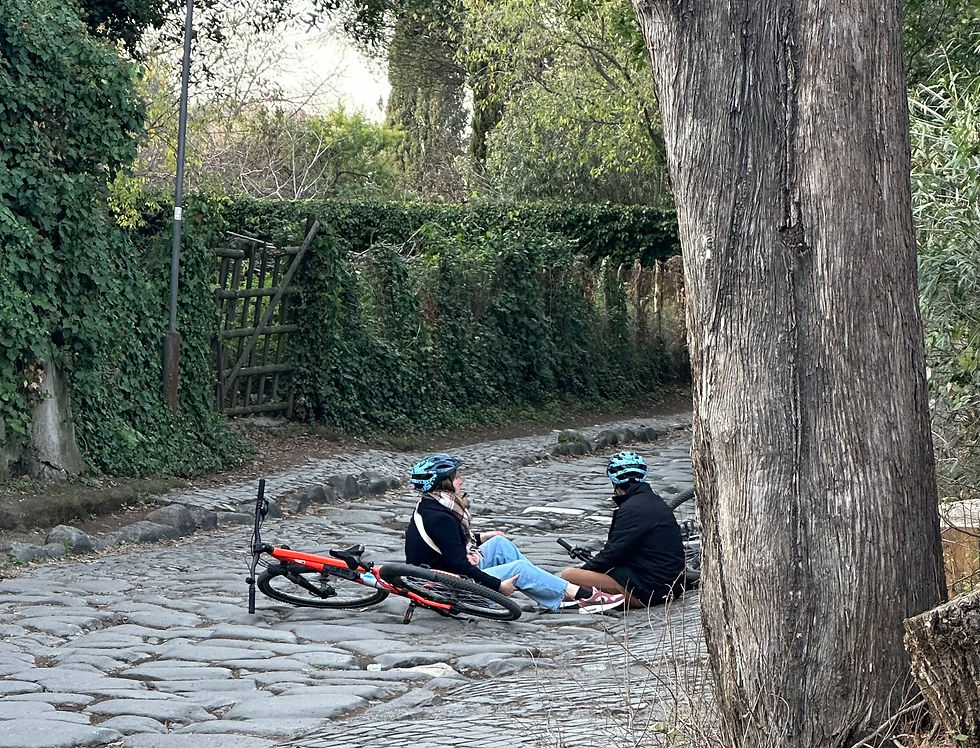
The ancient blocks of stone – like stepping stones on my life's journey. Stepping, swaying, balancing, regaining my footing. And all of this in endless repetition. But with the certainty of moving on solid ground. Everyone has to learn to balance for themselves anyway. A pilgrimage experience in itself!
Station 6: Basilica di San Lorenzo Fuori le Mura

The cult of saints has thrived here since the reign of Emperor Constantine (314-324), not only in Rome but worldwide. Lorenzo, as a deacon, was also treasurer of the local church's assets. Emperor Valerian (253-260), hostile to Christians and avaricious, had Pope Sixtus III and his followers arrested and executed during a Mass. Lawrence was initially spared in order to release the church's treasures. However, he distributed these to parishioners and instead collected the "true treasure of the Church"—the poor, the sick and infirm, widows, orphans, and the destitute—and presented it to the emperor. Lawrence was burned to death on a red-hot iron grade. Since then, he has been the patron saint of trades involving fire—for example, cooks, bakers, and brewers. He is also invoked worldwide for help with lumbago and sciatica.
Pilgrims in the Holy Year 2025 pay their respects to Lorenzo in the crypt before the marble sarcophagus.

In the height of summer, the atmosphere in front of the basilica becomes quite secular and lively, especially on August 10th, the saint's death day, when shooting stars streak across the night sky during the Notte delle Stelle (Night of the Stars). Pyrotechnicians have a hand in it:
Deeply religious pilgrims or culture enthusiasts?
Many Romans integrate their faith into everyday life. Religion doesn't seem forced, like something a churchgoer would do. I've had similar experiences with people from other countries and continents, and I've also seen people interested in culture. For me, this church tour in this unusual year is a cultural journey. I'm experiencing firsthand the high Christian culture (not only) of the Western world.
What type of pilgrim is represented in this photo series? Everyone can decide that for themselves.
This is not the end of my pilgrimage.
Everything – including me – is building towards its climax:
la Basilica di San Pietro in Vaticano.
For Christmas.



Comments