

Rome's ancient summer retreat in the Gulf of Naples

Pompeii's ruins tell vivid stories - Part 1

Off to the summer resort!
Summers in Rome are hot, even in the Roman Republic and the Imperial era. In the sweltering summer heat, the Tiber marshes were a breeding ground for germs, and their drainage had been a futile endeavor for millennia. Caesars, emperors, and popes lacked the necessary technical know-how; only Mussolini's fascists finally mastered the marshes.

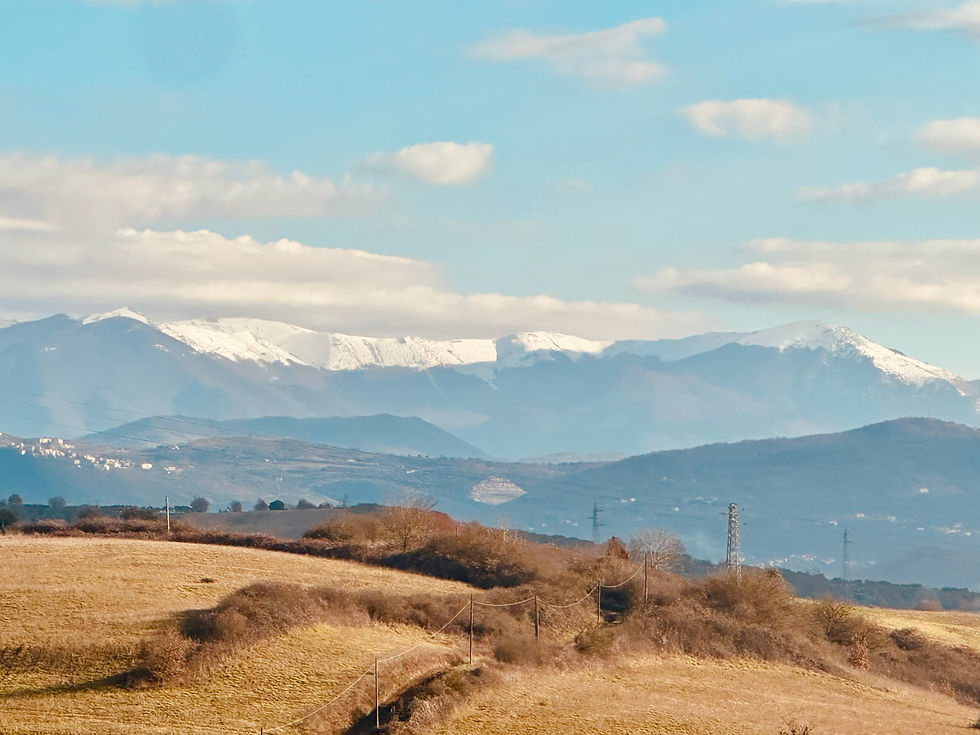
Those who could afford it escaped the city for a summer retreat. Pompeii, located about 250 km south on the cool slopes of the Abruzzo mountains, with its proximity to the refreshing waves of the Mediterranean, was one such haven for the Roman elite. The slopes of Mount Vesuvius also beckoned with good wine and fresh air.

The ancient Roman road Via Appia Antica had promised a quick arrival in the southern summer quarters since 312 BC.
Today, the A1, Autostrada del Sol, the main traffic artery between Rome, Naples and Pompeii, does not follow the old route directly, but runs a little further inland.
Sex, Drugs and Rock'n'Roll
A motto from the exuberant rock music scene of the 1970s would be anachronistic for the hedonistic lifestyle in ancient Pompeii."Vino, donna e canto" (wine, women, and songs) captures the spirit of earthly pleasures at that time much better. "Bacco, tabacco e Venere" (Bacchus, tobacco, and Venus) – a similar idiom of enjoyment. Although, tobacco didn't arrive in Europe until after the discovery of America in the late 15th century. But dried herbs and opium were already being consumed in ancient Rome and Pompeii. For pleasure and health.
The superb archaeological achievement of the last three centuries has brought astonishing things to light from the sunken Pompeii for us today: architectural traces of an enjoyable, easy lifestyle (Part 1 of my tour report) as well as evidence of a highly developed civilization (Part 2).

There's so much to see in the ruined city under the clear January sun of 2026. A short breather on a millennia-old remnant of wall. I'm aiming for 15,000 healthy steps on my five-hour excursion, filled with breathtaking scenery. And all this while balancing on uneven basalt blocks.
Bacco e tabacco - Inns and shops
Enjoying life in ancient Pompeii began with eating out, even during the day. This was often for convenience and to catch up on the latest local news. Few houses had a kitchen. A good and affordable alternative was a termopolio, offering hot food and cold drinks, including wine. It was a kind of hybrid establishment, a blend of a modern Italian bar (serving coffee, cornetti, and wine) and a tavola calda. Here you would find the finest street food, freshly prepared with local produce. To call it fast food would be a culinary understatement.
The sales counter featured round indentations to keep the food warm. The building boasted eye-catching architecture, open to the street, with a mural displaying the menu: duck, chicken, wild boar. Dogs had to be kept on a leash. During excavations, even an intact cash box containing the day's takings was discovered.
Likewise, a bakery with a millstone and oven remained intact under the volcanic ash, containing burnt round flatbreads from the day of the volcanic eruption.


Along with a multitude of other small shops (tabernae), restaurants and inns lined the Via dell'Abbondanza, the street of abundance, so named by archaeologists because of the rich range of goods on the main street.
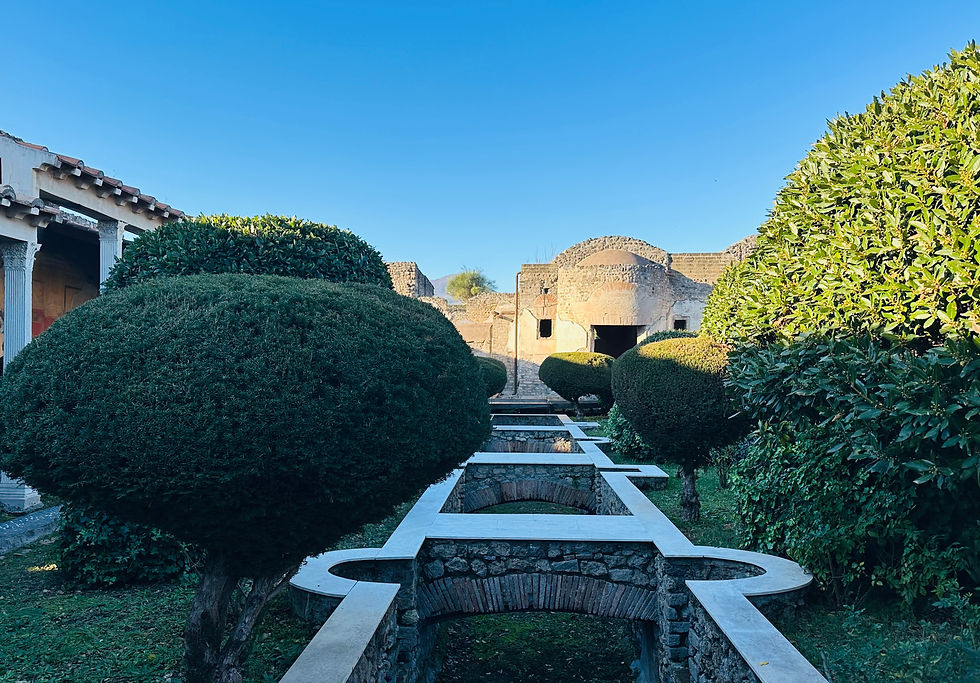
Dining could also be more stylish: in private homes and public buildings, in the sala triclinare, a dining room with comfortable marble chaise longues arranged in groups of three, perfect for long hours of feasting and conversation. The gourmets' gazes fell upon a garden in the courtyard with lush vegetation, decorative statues, babbling fountains, and shady colonnades. The entire landscape ensemble of a noble domus romanus, affordable to wealthy locals and summer visitors from Rome alike.

Giulia Felice owned such a luxury property and possessed considerable business acumen. As early as 50 BC, she ran a lucrative business in her casa, operating a hotel, restaurant, and bathing establishment for a discerning summer clientele.

Venere - sensual and intellectual pleasures
The hedonistic Pompeii took place primarily between brothels and thermal baths.
Establishments offering prostitution abounded in ancient Pompeii. Public red arrows painted on the walls of buildings pointed the way to them. The style of these brothels ranged from bawdy to refined. The city-wide prevalence of erotic frescoes testifies to the openly practiced lust for love among Pompeians.

During the excavations, explicit erotic wall paintings were kept from the public until the 1970s.
The cheap brothels were known as lupanara. The name likely derives from the she-wolf (lupa), a suggestive term for the provocative solicitations of the prostitutes, mostly slaves from Greece and the eastern territories of the Roman Empire. These women worked diligently in small cells on stone beds. Curtains, rather than doors, provided minimal privacy. Frescoes depicting imaginative sexual positions presented the erotic menu for heterosexual, homosexual, and group sex. A visual media world even back then! A single latrine had to suffice for a dozen sex workers and their busy clientele. Some clients left graffiti on the walls indicating their level of satisfaction and sex tariffs. Intimate encounters were also suspected in spartan private rooms of taverns. At that time, there were around two dozen brothels in the city, as common as Italian bars are in a small town today.
Free love was also practiced in a more stylish way in Pompeii. Archaeologists conclude from fresco finds that there was an Eros culture in an upscale setting. For example, in the Casa di Venere in conchiglia (Venus in the shell). Long before Botticelli would paint the Roman goddess of love centuries later, she already adorned a colonnade in Pompeii:

Similar erotic frescoes portraying a sensually emphasized lifestyle can be found in the Casa di D. Octavius Quartio, whose owner is identified by name via a bronze inscription in the atrium:


The two-story Casa degli Amanti is named after a Latin inscription on the wall: "Lovers lead a honey-sweet life like bees":
Teatri, terme e palestre
The idea that the mind can only thrive in a healthy body (mens sana in corpore sano) was also self-evident wisdom to the people of Pompeii. Gyms were particularly attractive to young men.
The Stabian Baths (2nd century BC) are located in the heart of the city. They offered sauna fun, bathing pleasure, with separate facilities for both sexes, and athletic training exclusively for men. The fairer sex cultivated its natural bella figura. Thanks to Roman hydraulic engineering, the walls and floors were heated.
Dramatic performances took place in the Teatro Grande (2nd century BC):

The amphitheater could accommodate up to 20.000 spectators, featuring spectacular shows such as chariot races and gladiatorial combats:


Other cultural sites are based on assumptions suggested by the fresco motifs. The Casa del Poeta tragico is named after a scene from Homer's Iliad, a dramatic epic and a popular topic of conversation in literary salons. The well-preserved fresco find is so valuable that it is kept in the Museo Archeologico Nazionale (MAN) in Naples:
Ancient Pompeii -
an urban high culture with a settlement history,
which dates back to the 6th century BC.
La dolce vita pompeiana lasts until the fateful day
on August 24, 79 AD,
as a primal volcanic force
brings civilization to an abrupt end.
in Part 2
of my Pompeii tour!



Comments