

Acqua - Rome's lifeblood

Exploring the Roman water network - Part 1

Rome's life-giver
Rome and water – an eternal alliance since ancient times. Water bubbles everywhere. Like a vast network of veins and arteries, water floods the city. No district, no suburb, no avenue, no street, no alley, no path, no corner, no square, no park, no elegant private residence, no public building without an easily accessible water source: monumental fountains ( mostre fontane ) and ornamental fountains (fontane ), as well as (see Part 2) functional drinking fountains (fontanelle, nasoni ) and their modern evolution, the water houses (casette dell'acqua). They all tell a piece of Rome's urban history.
Running water has been a sign of advanced civilization and luxury since the first aqueduct in 312 BC. A highly developed water supply and sewage system enabled a high quality of life. Fountain architecture, in addition to its practical use, symbolized power.
Monumental fountains
La Mostra Paola On the Gianicolo, Rome's highest hill, the fountain is named after its patron, Pope Paul VI. The Romans call the gigantic fountain "fontanone." From the Piazza Gianicolo, an unparalleled panoramic view opens up of the city and its skyline, which boasts over 2300 years of history.
Although the Baroque fountain (1612) is much younger than the ancient aqueduct, Aqua Traiana (109 AD), at the end of which it stands, it uses the same source that the ancient Romans tapped. Water from the surrounding hills was conveyed over 60 km or more underground via pipes or arched bridges to the city reservoir and from there via pressurized aqueducts to the seven hills of Rome. An impressive feat of engineering in the distant past!
Utility water, not drinking water, gushes from the monumental fountains. People rest at the edge, quenching their aesthetic thirst or relaxing their tired feet. A refreshing foot bath, or even a partial or full-body soak, in this or any other Italian fountain will result in a hefty fine from the vigilant polizia locale. Such a dip can cost €160, and on hot days, fines increase dramatically.
The legendary bath of Swedish actress Anita Ekberg with her film lover Marcello Mastroianni in the Trevi Fountain during the filming of La Dolce Vita (1960) - remember? It only led to worldwide fame back then.
The Trevi Fountain is fed by the Virgin aqueduct (19 BC), the only ancient aqueduct that remains intact and in operation to this day. Even a simpler model, such as the themed fountain Fontana della Barcaccia in the Piazza di Spagna (1629) is supplied by this spring, along with 70 others in the city. The flat-bottomed boat was a common means of transporting barrels of wine and oil on the Tiber. Pope Urban VIII Barberini commissioned the boat fountain as a decorative memorial. During the Tiber's flood of 1598, boats were washed as far as this spot at the foot of the Spanish Steps.

The Trevi Fountain is popular as a wishing well. Every year, masses of people flock to the fountain. A single coin doesn't mean much to the individual – materially speaking. The annual collection of approximately 33 tons of coins brings the city around €1.5 million. The coins, tossed into the fountain by an average of 35 million tourists annually, are fished out daily by official collectors. The money goes to soup kitchens and other charitable causes. Such a toss over one's back carries symbolic weight. It's about being blind yet open to the future. About returning.
As early as the Holy Year of 2025, visitor flows were channeled, with a limit on the time spent at the fountain's edge. Starting in January 2026, Rome will charge coin throwers €2. Locals can access the basin for free. Tourists gladly pay the fee. The influx of visitors continues.

Decorative fountain
Even in these Baroque creations, beauty takes precedence over utility. Nothing for the thirsty throat, but much for the eye. Art and social function merge here. Once again, it was papal and aristocratic patrons who wanted to beautify the cityscape. Thus, the most magnificent examples can be found in the Vatican and in public squares in front of churches, elegant palazzi (residences), and government buildings.
Fontane in Piazza (1) di San Pietro , (2) di Santa Maria Maggiore, (3) del Viminale (seat of the Ministry of the Interior on one of the seven hills of Rome), (4) del Quirinale (official residence of the President of the Republic on another hill), (5-6) del Campidoglio (seat of the Mayor on the Capitoline Hill).
Urban planner and sculptor Gian Lorenzo Bernini
(1598-1680) aestheticized the cityscape like no other artist. His marble statues adorn public squares as well as secular buildings and churches. His city fountains are among the most beautiful in Rome.
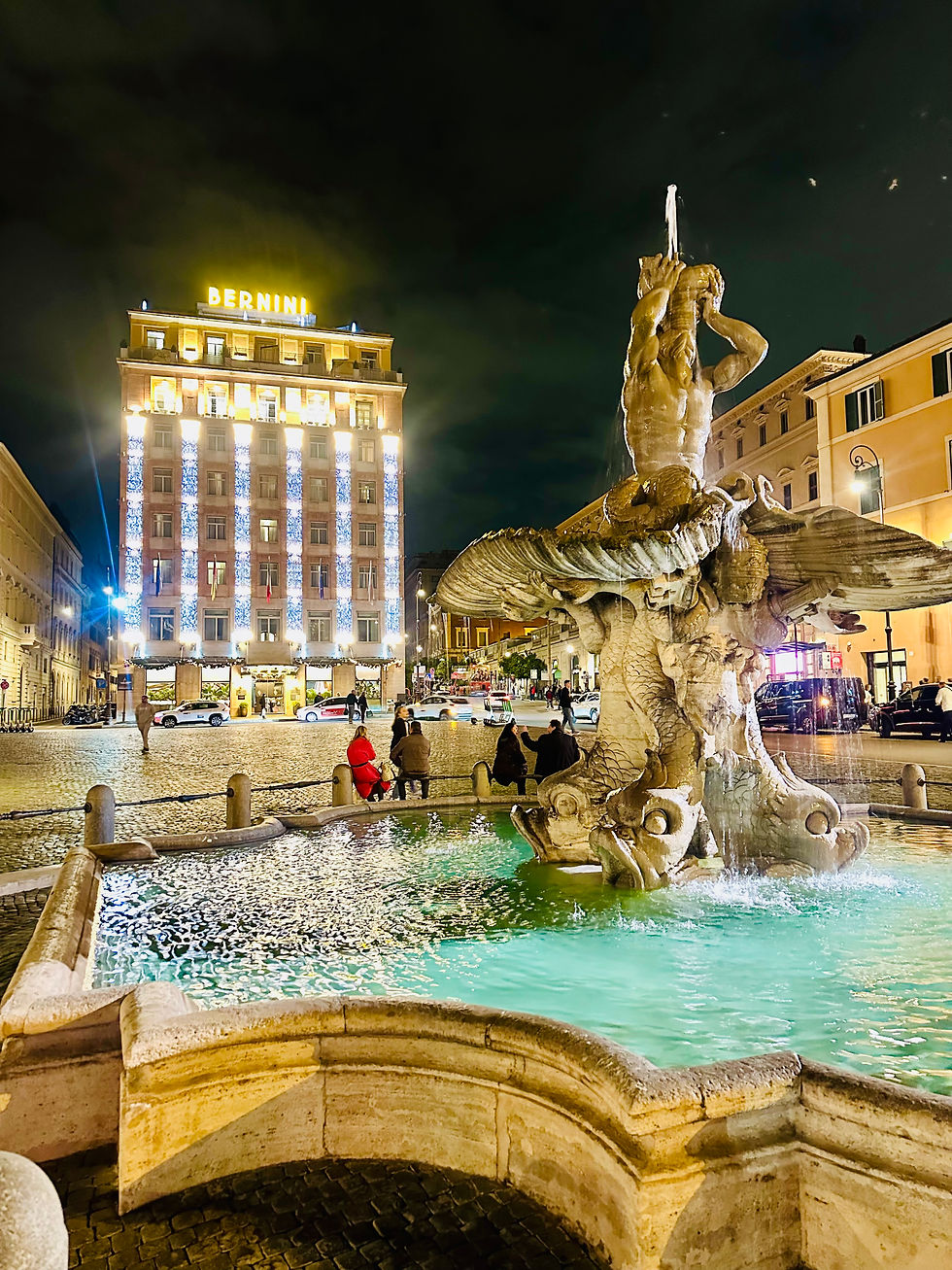
Bernini, too, had papal patrons, such as Urban VIII Barberini. Someone certainly with self-interest. The sculptor was commissioned to decorate the Piazza Barberini in front of the wealthy Tuscan papal family's new palazzo with a grand fountain befitting their status. The imposing Fontana del Tritone (1642) lent the district, which until then had been characterized by vineyards and garden villas, a stylish urban character. With the singing sea god, a hybrid creature of man and fish, Bernini not only embodies a figure from Greek mythology but also spreads the fame of the papal family through its song. The three Barberini bees from the family coat of arms represent diligence, thrift, resilience, and sweetness (mildness) – fitting for both the powerful and devout family and the Church.
Similarly, the Via Vittorio Veneto, branching off from the piazza —long before its fashionable reputation as a hotspot for the rich and famous in the 1950s and 60s— received a cultural boost with Bernini's marble sculptures. The artist initially envisioned the Fontana delle Api (1644) as a practical horse trough. However, in keeping with his patron's wishes, he incorporated the family's heraldic animals (bees— api) into the shell-shaped basin, thus paying further homage to the influential Barberini clan. And, of course, the papal patron had his name inscribed in the shell - for all eternity.

Bernini's Fontana dei Quattro Fiumi (1648-51) in Piazza Navona is considered the masterpiece of both the artist and the Baroque period, the most beautiful fountain in Rome—and, some say, in the world. It was commissioned by the next pope, Innocent X. The piazza was intended to become a social stage for his influential aristocratic family, the Pamphiljs, who resided there.

The river gods in the Fountain of the Four Rivers represent four rivers from the continents known at the time: the Danube (Europe), the Ganges (Asia), the Nile (Africa), and the Rio de la Plata (America), identifiable by the plants typical of their respective regions. At the top of the Egyptian obelisk, a dove, the emblem of the Pamphilj clan, embodies the papal claim to power over the entire globe.
Often unimpressed by this symbolism of power, people around the fountain engage in conversation, culinary experiences, and street art. The social function of ancient fountain culture for the popolo romano, the Roman people lives on.


Gods of the water and their companions
Pre-Christian Rome adopted the polytheistic religion of the Greeks. Deities responsible for water and military strength found pictorial form in Rome's fountain architecture – reflecting the appreciation and protection of water as the origin and elixir of life.
Thus, in the Fontana della Dea Roma (1823) in the Piazza del Popolo, two statues lie at the feet of the soldierly goddess of Rome, seeking protection. These statues represent the two life-givers of Rome, the rivers Tiber and Aniene. According to legend, the she-wolf between them symbolizes the life-sustaining power of the Tiber's waters for the abandoned twins Romulus and Remus.

The useful fountain at the obelisk, on the other hand, serves more to cool off in the hot summer:

The symbolism of the ornamental fountains Fontane Tirreno e Adriatico at the Vittoriano, the magnificent building for the first king of Italy, Vittorio Emanuele II, pays homage to the two seas that wash around Italy's boot:
On Piazza Bernardo, the colossal Fontana del Mosè houses sculptures from biblical water mythology in its niches: in the center, Moses parting the Red Sea to allow the Israelites to escape from Egypt, and striking water from a rock to save his thirsty people in the desert.
In the Fontana delle Naiadi (Fountain of the Nymphs, 1901) in the Piazza della Repubblica, four nymphs defend vital water sources—rivers, lakes, seas, and groundwater—against hostile aquatic creatures. The outcry in the puritan kingdom at the sight of the sensual poses of naked female bodies ultimately subsided when, ten years later, an equally stark-naked, athletically sculpted, but male statue mingled with the nymphs. Glauco, Neptune's son, was accepted without protest.

On January 23, 2026, sculptures and fountains spread joy of life on a sad occasion: Fashion designer Valentino Garavani (93) is bid farewell by family, companions and stars in the Basilica S. Maria degli Angeli e dei Martiri and, around the fountain, is celebrated by his fans.

A standing ovation from the crowd, including Sophia Loren (91), lifelong client and friend of the couturier, Donatella Versace (70), head designer of the Milanese fashion house, and Alessandro Michele, Valentino's creative director. A police salute and glorious blue-sky weather with 20°C of sunshine for the farewell to the last imperatore della moda.
Valentino and the nymph models. Appreciating female beauty and elegantly enveloping women in his fashionable gowns was his life's work and global success.



Comments