

Villa Adriana - more than an imperial palace

Retreat and regency at the gates of Rome in Tivoli

A villa in ancient Rome
outside the city walls is not a country house, but a country estate.

Emperor Hadrian's estate is such a rural residence. A palace town located 6 km from Tivoli (Tibur), today part of the Metropolitan City of Rome. Clearly chosen with the instinct of a property developer. "Location is everything" – a maxim that still held true at the time, and today's real estate agents couldn't have advised better:

climatically favorable position at 150 m altitude
panoramic view of the hills of Tivoli
convenient connection to Rome via the Via Tiburtina
land developed for construction with a palace from the republican period
Tiburtan quarries for building materials
tuff as soft subsoil for underground supply routes
water supply through the nearby Aqua Marcia , the world's largest aqueduct at the time
A colossal construction project, commissioned by Hadrian one year after taking office in 117 AD, he oversaw it himself as construction manager and used it as his primary residence until his death in 138 AD. It is the largest palace ever built by an emperor and the best-preserved from the Roman period. Villa Adriana covers approximately 120 hectares. That's 12 km², enough space for 300 football fields. Between 20,000 and 40,000 workers were employed during the construction phase from 118 to 134 AD. Up to 20,000 people lived there after its completion, including an estimated 5,000 slaves.
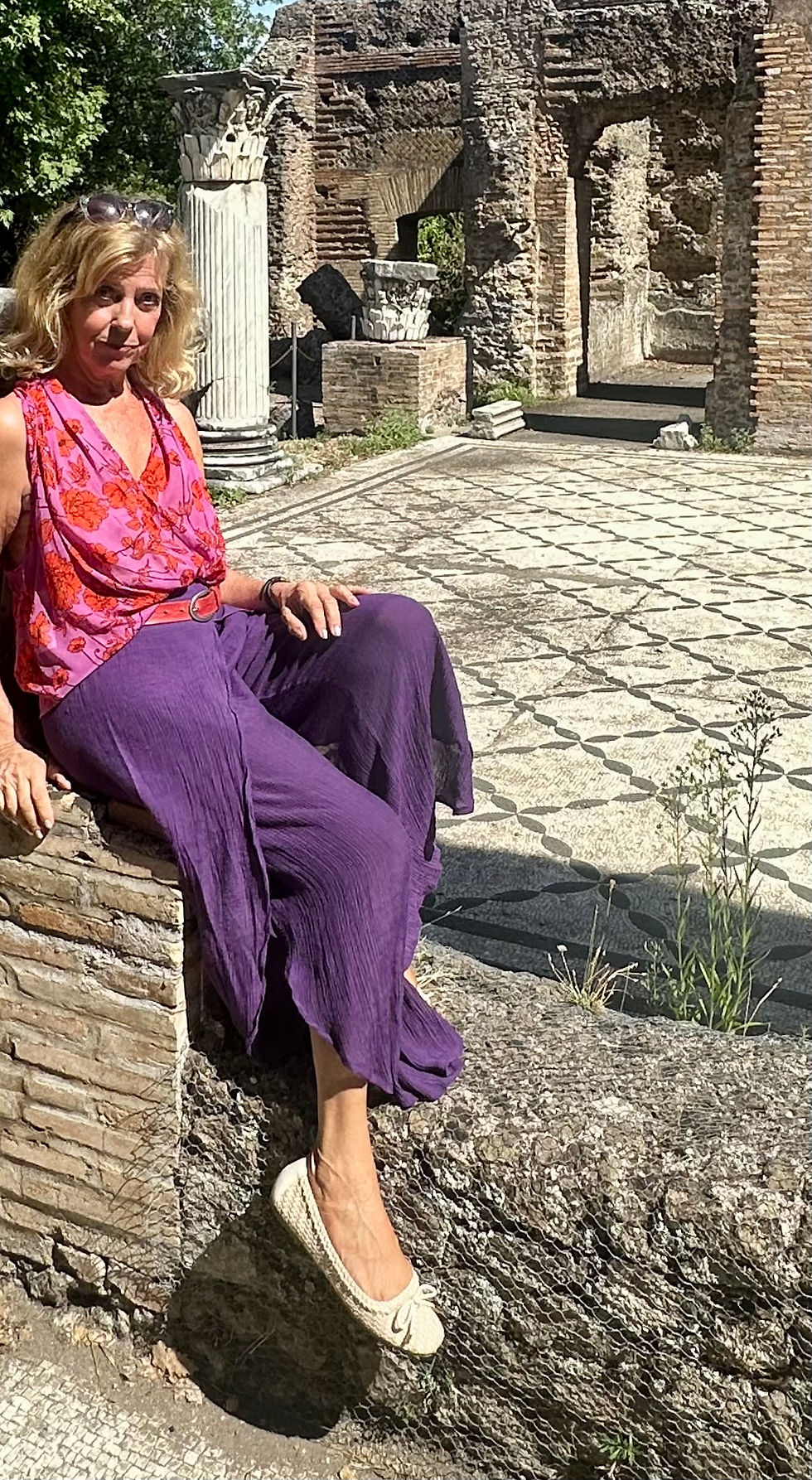
Approximately 40 hectares of Hadrian's Villa, with its 30 remaining buildings, can still be visited today. I set aside five hours of leisure, pack three liters of water, and subjected my feet to around 15,000 steps, with stopovers, as in keeping with the style, like here in front of a Corinthian column. And there's no question: I didn't manage to see all 30 ruins.
The ravages of time have caused the loss of the building structures. Fragile buildings are closed to the public. Or construction fences block off areas from the public where ancient structures are suspected to still be found underneath and excavations are currently underway. Excavations continue long after the villa's rediscovery in the 15th century. Even in 2024, archaeologists are still unearthing sunken treasures. For example, Storica National Geographic reports on a stately banquet hall in the center of a pool ( www.storicang.it ).
Summer residence for imperial pleasure?
Not at all. Not a pleasure palace, the kind built for a short stay of aristocratic residents, away from court ceremonies and official business.
Hadrian planned his private residence differently. As a place for retreat and government business, for otium and negotium —leisure and work. Rome, with the imperial palace on the Palatine Hill, remained the political and administrative center of the empire.
Government and entertainment districts – that's how I categorized the multitude of buildings, thermal baths, temples, theaters, stadiums, nymphaeums, and ornamental fountains during my visit to the villa. Otherwise, I'd get lost.
The government district
The palace complex was the first to be completed, featuring spacious rooms for work, meetings, and audiences. Archaeologists named some buildings according to their presumed use, sometimes fancifully, with the prefix "detto", meaning "so-called."
The so-called libraries were work spaces: Biblioteca greca e latina
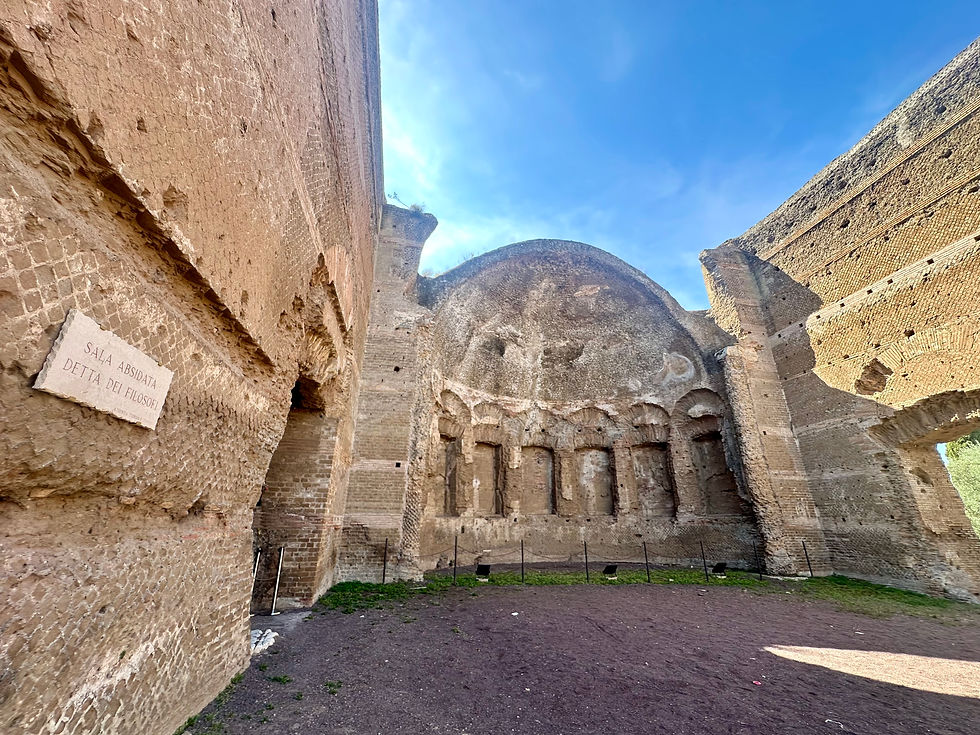
The so-called Sala dei filosofi was used for receptions:
The Teatro Marittimo was not an official palace hall. Only its circular architecture resembled a theater. In fact, it was the private retreat of the imperial manager. An island pavilion, surrounded by water and a circular structure, a miniature villa with every comfort, including a thermal bath.
Guest accommodations were plentiful. The rank of visitors can be seen in the amenities and proximity to the imperial palace.

Marble in shades of green, yellow, and red from the empire's distant provinces, such as Turkey and Egypt, was used in rooms for senior government officials.

Black and white floor mosaics from Italian marble quarries were part of the simple furnishings in accommodations for lower-ranking visitors.


An large residential complex, far from the sight of the emperor and his noble guests, was uncovered from the earth in the early 2000s. Up to 1,500 ordinary servants lived in tiny plots with service rooms on both high and low levels. Cento Camerelle , or 100 small rooms, is the almost affectionate nickname the discoverers gave for this ancient mass housing:

Dining rooms were also socially marked: simple square columns (pilastri ) in halls for lower government officials (praetori ); ornate round columns (colonne) with capitals as the more sophisticated furnishings for those higher in the hierarchy.

The restaurant, known as the Triclini Imperiali, is not imperial. Its proximity to the Hospitalia suggests a simple restaurant. What visitors today touch and understand as artistic is, indeed, real, but not authentic. The columns with stylish Corinthian capitals were evidently brought into play and into the dining room by archaeologists for decorative reasons:
In keeping with his status, the emperor dined with his high-ranking guests elsewhere, in the Quadriportico con Peschiera , a multi-story residential and representation building with a pool for ornamental fish (peschiera ).

The view of the water basin in the courtyard with its colonnades and further on to the hills of Tivoli clearly speaks for stately summer receptions and banquets.
Year-round operation was ensured by an air conditioning system that hydraulically pumped water through pipes in the walls and floors. This water flowed from a cool aqueduct in the summer and was heated in the winter by wood-burning stoves in the basement. The archaeological nickname, Palazzo d'Inverno, or Winter Palace, pays tribute to the talented heating engineers and their air-conditioning system almost 2,000 years ago, known at the time as the hypocaust system .

Class distinctions also determined wall decoration. Marble slabs, frescoes, reliefs, friezes, and niches for marble statues can be found in imperial quarters. Simple wall paintings adorned guest quarters.
The social hierarchy didn't stop at the latrines either. Individual latrines in marble designs for the emperor and his ilk, communal latrines with functional facilities for servants and sauna users. All were squat toilets, Turkish style , but comfortable with flushing.
Not far from the Winter Palace lies an even more impressive complex for imperial receptions and supreme court business, the Sala dei Pilastri Dorici. This spacious, open square was likely once covered.
The Sala separates the government district from the Piazza d'Oro at its rear. And so I walk straight into the ...
... entertainment district
On the Piazza d'Oro, I'm impressed by a huge pool with surrounding gardens, a water fountain (ninfeo ) on one narrow side, and a building with guest rooms and private toilets on the other. It's an excellent place for dining outdoors or under roofs, and for leisurely strolls. Much of the imperial design, including multicolored marble floors, columns, and sculptures, was plundered as building material or collector's items.

Can this leisure and recreation area be topped? After all, the Villa Adriana near Tivoli inspired the designers of the Tivoli Gardens amusement park in Copenhagen when choosing its name.
Yes, my senses and steps are heading toward climaxes. With more will than strength. And addicted to shady areas. I find them in abundance under the centuries-old olive trees:

Then, with renewed vigor, I head for the spa complex. The emperor sought relaxation at the Piccole Terme . The Grandi Terme were for the villa inhabitants:


Separate bathrooms, latrines, and exercise rooms for men and women, as well as simple black-and-white micro-mosaics on the floor, indicate a much-frequented wellness oasis for guests and residents.
Underfloor and wall heating were part of the standard thermal equipment in the villa.
Luxury for everyone!
The last stop on my antique tour is the true gem of Villa Adriana:
Canopo e Serapeo, an exotic-looking building with a water basin and pavilion:
This beautifully restored complex brings together the travel impressions of an emperor who, as an art-loving globetrotter, combined styles from his provinces of Egypt, Greece, and Persia with Roman architectural elements.
Egyptian:
the canal that connects the city of Canopus with Alexandria
the pavilion as a replica of the Serapis Temple
the crocodile at the edge of the pool
the Nile as a father figure
Greek:
Caryatids from the Acropolis
war god Aries and warrior Theseus
columns with Corinthian capitals

Roman or Persian:
the Tiber as a father figure
round arches and domes
Hadrian's "Golden Age"
Villa Adriana – a display of imperial power? You'd almost believe it once you've seen this stunning area.
But for the Roman Empire, his reign was a time of stabilization: Hadrian returned recent conquests under Trajan in the East and on the Danube to the rebellious peoples, secured the military's strength, established legal systems as a permanent body of rules, promoted diversity, education, prosperity, and infrastructure, cultivated cultural traditions, and tolerated ethnic customs. He maintained historical buildings and, in addition to the villa, built Castel Sant'Angelo (his mausoleum) and the Pantheon.

And he died of natural causes at the age of 62, without murder or manslaughter in the struggle for the succession. One of the few in the Roman Empire to do so. Everything speaks for Adriano as a ruler with resepct and understanding for the people(s) in the Roman Empire.
The fact that the 14th Roman emperor, with his Greek hairstyle – short, curly hair and full beard –, was able to inspire young contemporaries for Hellenistic culture almost sounds like a pop-cultural talent.


Comments