

La Basilica di San Pietro - End of the pilgrimage

Through the Porta Santa to heavenly pleasure

The Papal Headquarters
I'm saving it for last. For Roman Christmas Eve. La Vigilia di Natale is just the eve of Christmas in the local language, nothing particularly holy about it. The last-minute Christmas shopping business is booming. Just look at all the things Romans bring home on Christmas Eve!

Cyclamen, for example, to liven up balconies and terraces that have become desolate in winter. Mistletoe sprigs for house or apartment entrances are selling like hotcakes. And in Rome, it's still a popular spot for kissing.

Poinsettias, ranging in height from half a meter to a meter, are also in season. They are often available in durable plastic, artificial plants. These can be reused for subsequent occasions, for example as floral decorations in beach cafés during the summer.
Panettone or Pandoro! These iconic Italian cakes come in two shapes, bowl or star, with all kinds of fillings – candied and fresh fruits, hazelnut, pistachio, chocolate, nougat – and are presented in artistic packaging, representing the best that can be created from a secret recipe in an Italian pastry shop.
Then, on Christmas Eve, Roman shoppers buy lingerie. It has to be red for the Christian celebration of the birth of Christ, the women's underwear. Like the bright red plastic chili peppers on New Year's Day.
Red is said to bring good luck. But will it also revive the slump in Italy's birth rate? It's a problem in a country once known for its large families. Currently still below the German birth rate, at a meager 1.2%. It's less a question of romantic than of job opportunity. Chronic unemployment, especially among young professionals in southern Italy, doesn't entirely spare Rome's younger generation, regardless of the professional qualifications they can document with diplomas. Young women will only fall for marriage-minded men when, instead of offering diamonds, they can present recent bank statements showing a secure monthly income. Money first, then children. For well-educated Italian women, kitchen and church have lost their appeal anyway.
The keyword is "birth". People with German Christmas roots like us want a more festive atmosphere on December 24th. So off we go to the holy site. There we are in good company with hundreds of pilgrims.


Logistics are more complex for the Porta Santa in San Pietro. Registration is mandatory.
The iubilaeum25 app helps; the Vatican, in its Jubilee Year 2025, is IT-savvy. Registration with all biographical data, booking of date and time, meeting at Piazza Pia, picking up a prayer slip at the Info Point, waiting at a barrier – with the dome of St. Peter's Basilica already in sight – until a manageable group of 20-40 pilgrims has gathered, and a volunteer hands a light wooden cross to the first person in line, raises the barrier, and the pilgrimage procession sets off in step, praying or singing.
It is a 600 m pilgrimage route that is attracting media attention:
It gets quieter as we approach the checkpoint with the laser device and then go up the steps to the Porta Santa.
Inside the church, the pilgrimage disperses. Each person moves at their own pace through the sacred halls with their impressive design and precious decoration, pausing in devotion or exhausted by this concentrated power of sacred art and beauty.
Cathedral or basilica

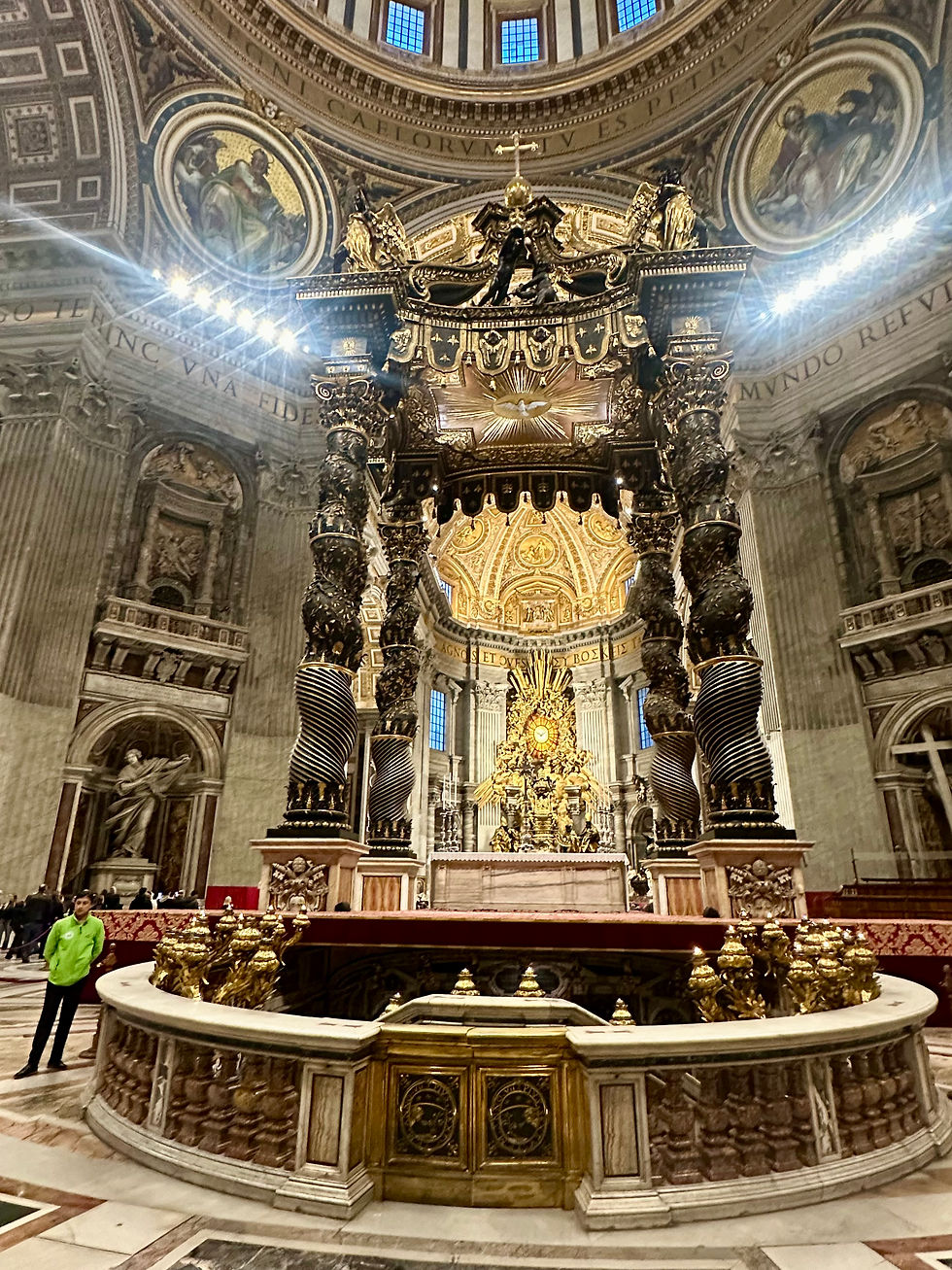
It's worth going outside. Piazza San Pietro is sparkling with Christmas lights.
Glory and prestige of the Roman papacy
Surrounded by a staff with multi-million-dollar salaries, in a residence gleaming with luxury goods from the Vatican Museums , as head of state of the Vatican City State and holder of all three branches of government in Europe's last absolute monarchy, courted by 1,000 employees with a guaranteed high level of education, a proud 100 percent literacy rate, and a similarly high percentage of Catholics, the Pope himself is penniless. He receives what he needs to live on. His territorial sphere of influence has also shrunk considerably.
The gradually widening view from the dome of St. Peter's Basilica is also a synopsis of Vatican history in the Papal States until the late 19th century.

The power center of the Catholic world arose from humble beginnings in ancient Roman times soon after the time of Jesus Christ, in the western Tiber marshes on Monte Vaticanus – a name given by Etruscan settlers. A burial site of the Apostle Peter erected in about 65 AD, the hill evolved in the 4th century into a place of worship and pilgrimage, with the first church dedicated to St. Peter.
In the 8th century, the popes laid the foundation for the future Papal States by establishing political control over the Roman territory. At the end of the 14th century – after the pope's return from Avignon in France – the pontifex maximus took up his seat of government on Vatican Hill. The subsequent building boom saw the construction of administrative buildings, churches and chapels, the papal palace, and fortifications. The Papal States were taking shape. The basilica replaced the earlier burial church in 1626. With the expansion of the Vatican, the Papal States also grew, encompassing a territory that, by the 19th century, stretched across central Italy from Bologna in the northeast to Rome in the southwest. The zenith of papal power had been reached. The popes were in no way inferior to the Roman emperors in terms of splendor and influence.

Even the title pontifex maximus (PM), "Supreme Bridge Builder," was adopted by the popes from Julius Caesar and the subsequent Roman emperors. A PM was a high-ranking official who attended to all public affairs, including weather forecasts, consulting the gods, scheduling and holding funeral services—and, of course, building bridges. Across the Tiber, the lifeline for supplying the ancient metropolis of Rome with goods. The PM was a hybrid figure, part magician and part politician, highly respected in society, a bridge builder in a figurative sense as well: a mediator between humans and gods. The popes liked that.

Then the tide of Vatican history turned. When the Italian city-states
joined up to form the United Kingdom in 1861, the secular possessions of the Roman Curia shrank to their very beginnings. Initially, the Papal States were reduced to Rome and its surrounding area. The Pope rejected annexation by the Kingdom in 1870. Then, Rome was lost to the nation-state as its capital. Only the Lateran Treaties of 1929 guaranteed Vatican City a limited degree of sovereignty within its current territory, enclosed by the narrow walls surrounding St. Peter's Basilica. An imposing statue of St. Peter, holding St. Pete's Key, greets visitors in front of St. Peter's Basilica.
Every 25 years
This wasn't always the case. After its inception in 1300, the cycle of the Holy Years was shortened from the planned 100 years to 50 due to the low life expectancy at the time. Empty coffers during plague years led to a further reduction to 25 years starting in 1475. In 2025, Rome anticipates a noticeable economic boost from the expected 35 million visitors in the Holy Year, even after deducting approximately 2 billion euros in investments for infrastructure projects.
Among other things, the new section of Line C of the Rome Metro(politana), which carries visitors to the historic center, was finally opened on December 16, 2025, after 12 years of planning an construction. A final station extending to the Vatican is on the list. Metro commuters should be prepared for more delayed construction due to the anticipated discovery of ancient archaeological finds in Rome's underground.
And what about the medieval tradition of indulgences? Everything has been relaxed. The length of the penitential walk, the amount of alms. No more treasure chest before the Holy Doors. No more certified letters of indulgence that must be purchased.

But there are contemporary and voluntary options. A testimonial of the completed pilgrimage, for which no proof is needed, is a very popular souvenir for only 3 Euro.

Similarly, commemorative medals for the Holy Year have collector value, then as now. Available at a reasonable price of 5 Euro from the vending machine at the official information point.
Every year again
Romans and globetrotters alike are drawn to the world's smallest state. While the secular power of Vatican City ended long ago after more than 1000 years of political rule in central Italy, what has endured through the ages is a highly concentrated wealth of architecture and artifacts, and the radiance of the Catholic faith, which, with the papal blessing urbi et orbi on Christmas Day, seeks to reach beyond the city of Rome to the entire globe.
We were there live this time, among a festive crowd of 26,000. This can be repeated annually if needed. But for the next Holy Year, we will need a spiritual impetus.
Buon Natale
Merry Christmas
in town and country
Italy - Germany - Turkey - India - Vietnam
where my blogger fans are celebrating


Comments