

Sutri - Etruscan, Roman, Papal, quite amazing

Getting out of Rome's heat storage to the northern outskirts

In the Heart of Tuscia

My new network of international expatriates and Roman residents invites me to an event that fits perfectly into the Roman midsummer.
That's where I want to go. Away from the 35°C in the city and into the inland with milder temps, I presume. Nothing like that! Another 4°C rise! But to compensate, a small town with a naturally cooling wind perched a lofty 300 meters above sea level on a tuff outcrop. Esquilino, Rome's highest of the seven hills, boasts of a modest 58 meters by comparison. And gone is the mantle of heat that has enveloped me in the capital, sapping my energy since the first days of August.

And Tuscia? Sounds like Tuscany. But is not true. It would also be too far for an aperitivo event. Another readjustment. Tusci was the Roman word for the inhabitants of the settled area between the Tiber and Arno. Etruscans had settled there long before Romans came and felt enticed to invade and conquer Etruscan territory and its people. Tuscia became a Roman province in the 4th/3rd century BC.
The name has endured, a geographical and historical designation for the land of origin, abundant with remains of its long past: north of Rome, in the south of Tuscany, and west of Umbria. Sutri, the ancient town , lies roughly midway between Rome and Viterbo.

On the pilgrimage route
The 60 km drive from Rome to Sutri is quickly mastered via autostrada and strada statale (SS2 Via Cassia). The winding, unlit road and the anticipation of a lively aperitivo session awaken my sense of pragmatism.

I need a hostel. There's only one of them in the borgo ( centro storico) of Sutri. It's within walking distance, a four-minute walk from the restaurant, our event location. The hotel's highly recognizable name: Sutrium. The letters of the Etruscan inscription, originally adapted from the Greek alphabet, then romanized, no longer mirror-inverted and readable from right to left.
A family business for 30 years, the albergo now accommodates in a handful of rooms travelers off the beaten the tourist tracks.

Since the Middle Ages, pilgrims have sought food and lodging here on their long journey from England or France along the Via Francigena, one of the main roads across the Frankish Empire to Rome. A stopover along the pilgrimage route? The Via Francigena is still active today, and Sutri is a sought-after stop for fresh food. I like the idea. Although the breakfast food next morning is frugal, even for an engine-powered car driver like me, and also by Italian standards. A pilgrim's meal, after all!

But who cares about that in a tuff town with a medieval flair, winding streets and inviting piazze, a bustling business scene, and restaurants on end? There's a supply of food and drink in town! The rate of € 50 is right, as is the friendly welcome from the hosts. The room could accomodate three guests, is clean, functional, and cool, nestled between thick natural stone walls. Two well-deserved stars!
In Franconia

Sutri was also located in the Roman Empire, which extended over large parts of Western, Central, and Southern Europe since the early Middle Ages, with its peak under Charlemagne (768-814). Carlo Magno was here! In Sutri! This is what I gather from a signpost along the art and history route through the town. Well then: off to the remains of his castello opposite the tuff hill!

What? Carlo Magno in a restricted area? I've long been a fan of those bad girls who get everywhere. Signs, especially in Italy with its creative interpretation of prohibitions, don't scare me. Well, there's not much to see beyond the protective shield. And for castle ruins from the early 9th century, the structure is incredibly intact, with no discernible signs of restoration.
The reason for the Sutrini 's pride in their famous temporary resident is probably only half the historical truth. A guest in Sutri, yes, perhaps, because in the early 8th century, with the Lombard king Liutprand's donation to Pope Gregory II, the city became the first non-Roman possession of the future Papal State, and from then on, it served as a meeting place for popes and emperors. It also became a bishopric. It also served as a synod meeting place. Pope Innocent IV (1243/4) was briefly exiled there, seeking refuge from Emperor Frederick II. Charlemagne's coronation as emperor in Rome in 800 AD marked the beginning of the Holy Roman Empire. Thus, there are enough historical points of contact between empire and church. That they should have materialized in a specific residence of Charlemagne in Sutri, however, remains a legend. Even Wiki and AI have verifiable factual knowledge: The castle's structure dates back to the 13th century. A lovely anachronism, then! And an equally pleasant view of the city from the castel:

Historic jewels
In contrast, the Etruscan rock tombs in the tuff caves beneath the old town of Sutri are genuine. The caves date back to the 6th to 4th centuries BC, the pre-Etruscan settlement age. Long since plundered and converted into a stable or shed, the necropolis is now used for nativity plays during the Christmas season.


Sutri's beginnings date back to that early time, documented by Roman historiography from the 5th century BC onwards. The commune is said to owe its origins and its name to the god Saturn, a derivation of the Etruscan word Sutrinas. The legend still lives on today in the town's coat of arms: Saturn holding three ears of grain, symbols of the area's fertile soil. And indeed: Sutri rose to become the economic and commercial center of Etruria. The royal crown and purple cloak herald the settlement's royal and imperial glory. Including papal splendour (see above)! What's more: During turbulent times of constant changes of power among the territorial rulers (5th/4th centuries to the Middle Ages), its strategic high position between two mountain complexes was used for military purposes as a bridgehead: for advances into the interior, and by the Romans also to ward off barbarian hordes attempting to advance along the Via Cassia to Rome.
What remains of 2500+ years of history?
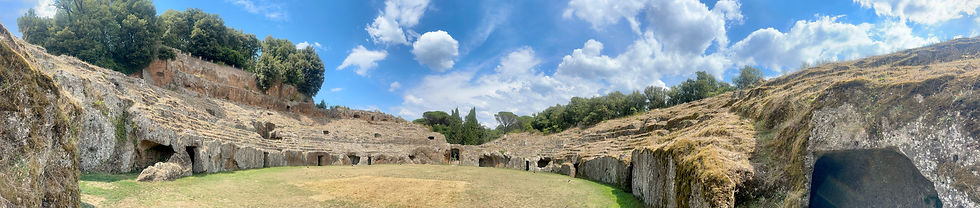
From Roman times? The anfiteatro. Carved entirely from a tuff wall (1st century BC/AD). A miniature version of the monumental Colosseum in Rome. But identical in layout and function: with three tiers of spectators and an arena, covered boxes for celebrities, and an ingenious access system via two entrances for up to 9,000 spectators. Ten doors lead into covered tunnels through which fighting animals and humans were channelled into the arena for bloody chases.
And from the Middle Ages ? Almost all of the medieval buildings in the borgo were destroyed by fire in 1433. Wood and clay buildings, roofed with straw and shingles, fueled a firestorm in the narrow streets. The old city walls with their gates, as well as the houses from the reconstruction phase and later, are solid stone structures. Today, the nearly 7,000 inhabitants are spread across the old town within the medieval city walls and the new town on the hillside.
The medieval city structure has remained: winding, narrow vicoli , through which cars rather roll than drive; piazze for people and traders:
Fountains and the old public washtub, antico lavatoio, from the earliest settlement times now serve as a watering hole:
And Sutri’s layered and recycled architecture is a testament to a centuries-old tradition:
Il Mitreo, originally a pagan place of worship of the god Mithras in the tuff next to the necropolis from the 1st/2nd century AD, was used by Christians as a rock chapel from the 13th century onwards. Frescoes depicting the veneration of the Virgin Mary and the Nativity, as well as pilgrimages along the Via Francigena, were added, and the name Chiesa della Madonna del Parto (Nativity) was introduced:


Several settlement periods - ancient, medieval and modern - these elements converge in the architecture od the Concattedrale di Santa Maria Assunta . The early 13th-century church rests on an ancient substructure, a pagan cult building. The Romanesque style of the façade was redesigned in the Baroque style and subsequently modified. Only the massive tuff stone campanile from the 10th century remains from the Middle Ages.
And finally, the city's history is reflected in the names of the numerous ristoranti: Locanda di Saturno, Osteria Il Mitreo, L'Anfiteatro, Ristorante Liutprando, Il Vescovado.

And last but not least, but equally important as diving deep into the history of the city hidden in the tuff, is our socializing event, l'incontro sociale, in the evening.
The Cantina del Drago invites you to a Summer Aperitivo and Light Dinner.

This robus construction, dating back to 1500, was first owned by a cardinal, then inhabited by the ancient noble Del Drago family from Viterbo. At the end of the 19th century, the principe had the cellar converted for wine production. Since 2016, the cantina has been a restaurant serving local and fusion cuisine that is appreciated not only by locals.
My primo piatto is actually too precious for consumption:

The service is great, the dishes are light, the conversation is casual, and the tables slowly fill up as the evening progresses, with no end in sight.

The town sign declares Sutri one of Italy's most beautiful towns for its rich historical and archaeological heritage. Such a cultural award from the Italian Tourism Council truly surprises me. Not in the least!



Comments