

Le donne di Mucha - Artistic advertising of sensual beauty

Updated: Nov 17, 2025
Alphonse Mucha's monumental exhibition at the Palazzo Bonaparte in Rome
Trionfo di bellezza e seduzione
Inspired by Sandro Botticelli's Renaissance Venus, 400 years and several painting styles later, Alphonse Mucha also dedicated himself to the "triumph of beauty and seduction".
In the late 19th century, with its growing economic power fueled by thriving industrial production, Mucha created women as protagonists and advertising figures in his posters. He translated the quiet, classical ideal of female beauty into a contemporary striking, sensual allure. He endowed his women with captivating gazes.
Equally seductive are bedroom eyes and lowered eyelids in feigned chastity:
The gazes from Mucha's women do not fail to have their effect. Men and women alike in our InterNations group feel magically drawn to them and strike poses:
The allure of the donne di Mucha has captivated people for more than125 years: leading them to purchase goods such as chocolate powder, Nestlé milk powder, Lefèvre-Utile pralines and biscuits, Rodo perfume, Mucha soap, JOB cigarette boxes, Meuse beer, and Moët & Chandon sparkling wine. Consumer goods like these are offered at the Paris-France department store. Founded in 1898, it soon expanded to 70 branches throughout France.

Muchas artful posters also advertise for the print production of the printing company Cassan Fils.
The erotic tension between the scantily clad woman in casual conversation with the robust factory worker in the printing shop is observed from all sides by pairs of eyes—voyeuristic customers who can profit from the innovative poster art. With the invention of color lithography in the 1890s, woodcuts, engravings, and etchings are considered obsolete techniques. Mass production is entering the fine arts.
Mucha's illustrations also advertise for major events such as theatre performances, the Monte Carlo motor races and the 1900 World's Fair in Paris.
The same applies to the salon culture of Parisian artists:

Commercial career of a poster artist
Mucha's colored hand drawings were produced in serial prints. His serigraphs delighted merchants and customers, art lovers on and off stage, became highly sought-after collector's items, and were in demand by newspapers and magazines to boost circulation.
During his 20 years as a poster artist in Paris, Mucha produced approximately 120 advertising posters, all in his characteristically narrow, vertical format, as well as menus, allegories of the seasons, personifications of the arts (see photos) and virtues, astrology and the zodiac. His 134 color illustrations for the French fairy tale Ilsée achieved enormous popularity through translations of the work into European languages.
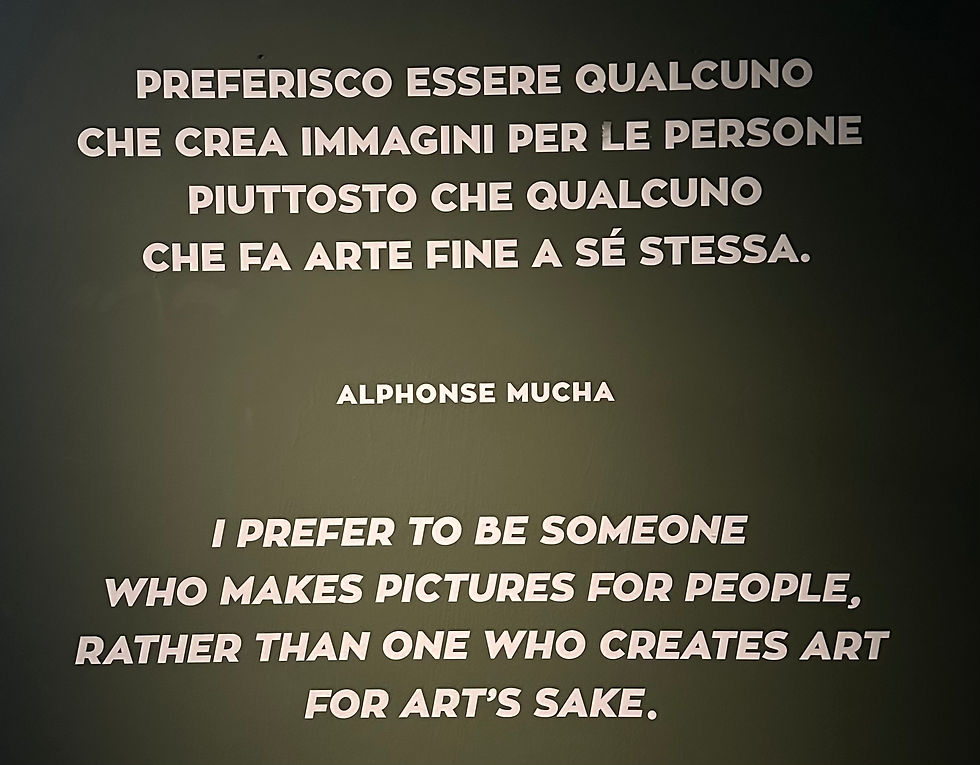
With his advertising posters, Mucha made the aesthetic Art Nouveau style a part of everyday life. This perfectly reflects his credo of creating images for people, not for art's sake.
As early as 1897, Mucha's poster art was considered the most important work of Art Nouveau illustration, a first highlight of Art Nouveau in retrospect, according to art experts. Alphonse Mucha, a world-renowned poster artist of the Belle Époque, a prime example of the artistic avantgarde at the Fin de siècle ! The French nation bestowed upon him honorary titles: Knight (1901) and Officer of the French Legion of Honor (1934).

From 1904 to 1906, Mucha held teaching positions at academies of fine arts in New York, Philadelphia, and Chicago, which also spread his reputation to the New World. The New York Times further boosted his fame with mass publications of his artistic posters.

The US film industry brought the "Greatest Decorator in the World" to the big screens and thus to mass audiences.
Mucha even made it to space. Postmortem. An asteroid discovered in 1989 bore his name ten years later.
How did a humble stage painter and book illustrator from Moravia (then part of Austria-Hungary, now part of the Czech Republic), with his early childhood talent for drawing, achieve such a meteoric artistic and commercial career at such a young age? He could never have done it with book illustrations alone. Certainly not in his homeland, so far removed from the pulse of modern life. Today, social media ensures wide distribution and fame – for people, products, and even fantasies.
What or who originally promoted Mucha? Luck and favor. Of a woman.
La divina Sarah

Already a world-renowned star on the Parisian stage in the late 19th century, Sarah Bernhardt (1844-1923) was destined to become a lasting icon thanks to Mucha's poster art. Neither she nor he suspected this, however, when in 1894 the stage actress needed a new illustrator to create a promotional poster for her play Gismonda. Time was running out before the premiere. She searched, he was there, and she hired him. On a trial basis. A self-taught artist with no prior experience, who had illustrated books and decorated rooms in stately homes in his homeland. And who was seeking connections in artistic circles in Montmartre.

Mucha's poster was designed and printed in just two weeks. It spread rapidly throughout Paris, the metropolis of art and culture, which acted as a catalyst, making Mucha's work known in the Western world. Success paid off. Mucha received a six-year contract (1895-1901) from the stage diva.
Six more theater posters for Bernhardt's stage performances would follow.

During this creative phase, Mucha continued to draw and color, design stage sets, theatre costumes and jewelry for the diva, and made a name for himself as a designer and art director at Sarah's theater.

Back to the roots – geographically and artistically.

Even before World War I, Mucha was drawn to Prague. There he realized a passion project (1911-1928): his Slav Epic, a cycle of 20 large-format paintings praising the achievements of the Slavic people, a gift from the artist to the city of Prague.

Even his Parisian posters, alongside motifs from Japanese, Islamic, and Greek ornamentation, displayed Slavic features: botanical elements, halos, and embroidery in the garments of his female figures. In turn-of-the-century Paris, Mucha thus sparked a wave of Slavic sympathy and gave women a new fashion trend.
Mucha continued his distinctive Slavic style as a painter in Prague. Even the banknotes of the young state of Czechoslovakia featured his Slavic designs.
Ultimately, his Slavic beliefs made him an enemy of the German occupiers in 1939. After a brief internment, Mucha (1860-1939), a wealthy lord of a castle north of Prague, died at almost 80 years of age.
Mucha's art up close
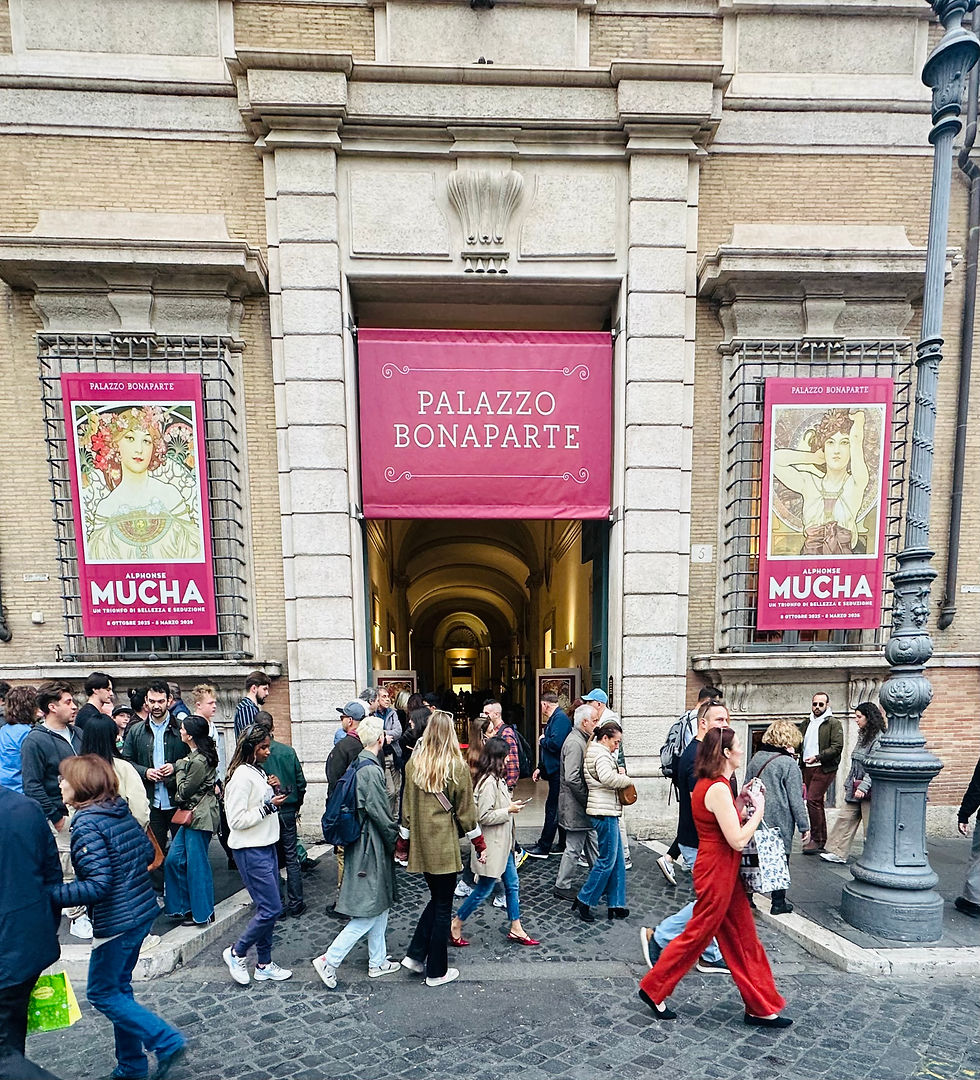
For six months, the Palazzo Bonaparte in Rome brings Alphonse Mucha's decorative art to life before our eyes in the exhibition "Un Trionfo di Bellezza e Seduzione" (A Triumph of Beauty and Seduction), displayed on the walls and in light installations. It's a first: a monumental show featuring 150 works by Mucha and other contributions from artists of his time during the Belle Époque. Botticelli's Venus, on loan from Turin's Musei Reali, is a true highlight. Only the Mucha Museum in Prague can rival this exhibition.

Visitors flock to the museum opposite the ongoing construction site of the Metropolitana, Linea C, on Piazza Venezia.

They pass the liveried receptionist and get into a darkened projection room with the first light installation: an ancient hero in his natural nakedness subtly enveloped by Mucha's flow of flowers.

Mucha's poster world keeps us captive for a long time. Botticelli's Venus too.
We climb up to the 2nd floor, pass exhibits by Mucha's contemporaries - paintings, furniture, household items and decorations.
and get to the visual Olympus of the Mucha exhibition: light installations in mirrored rooms. Visitors immerse themselves in Mucha's dynamic and heart-stirring artistic cosmos.
For a moment of sensual embrace by his colors and forms, I can feel the attraction of his icons in fin-de-siècle Paris.
No InterNations event is complete without a social gathering afterwards:



Comments