

A pilgrimage through Rome in the Jubilee Year 2025

Updated: Dec 18, 2025
Stage 1: Through three Holy Doors to a new spirit

Time for a pilgrimage
December morning. Saturday. Pure sunshine. Winter warmth. Ideal weather for pilgrimage. Roads still empty. Tank already full. Just in case. Cheerfulme, the "Pilgrim of Hope." One of the peregrinantes in spem, as the motto of the Holy Year goes.

The Holy Year 2025 is drawing to a close in Rome. I want to make my pilgrimage in good time, visiting the seven pilgrimage churches of Rome.
All the wings of the Holy Doors in the four papal basilicas, the main churches of Rome, are still open. Since Christmas Eve 2024.
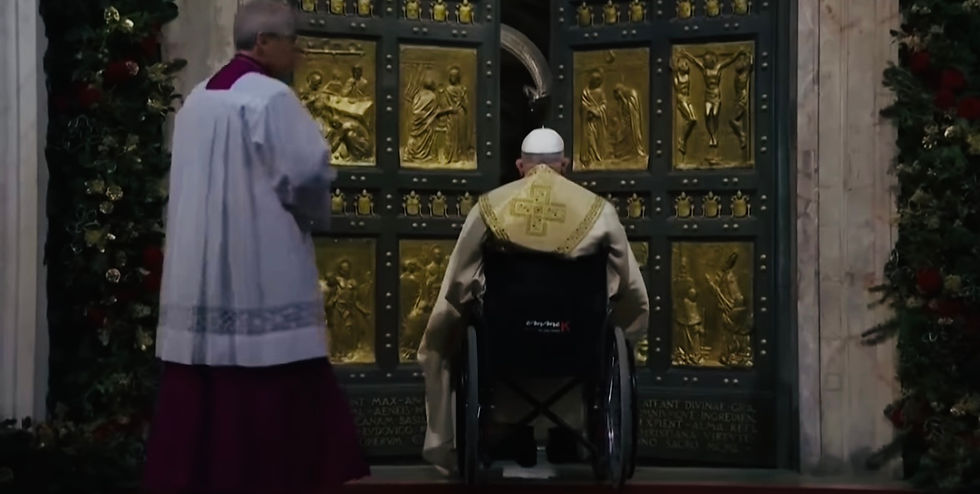
Pope Francis, in frail health, offered a prayer for the symbolic, energy-saving opening of the Porta Santa in San Pietro, powered by electricity. The traditional hammer blow against the bricked-up door is long gone. Who wants dust and debris in front of the church portal during this solemn ceremony every 25 years?! Especially with eyewitnesses—the Vatican's telephoto camera invites the entire world (urbi et orbi) to watch. Sustainable thinking saves the unceremonious cleanup crew. Sealing it for the next 24 years will do just fine.

The deadline is January 6, 2026. This time, Pope Leone XIV will be the celebrant, the energetic and sports-loving successor of his deceased predecessor, twenty years younger. But it will remain a symbolic ritual, without any bricks or mortar.
Logistical preparation

of my seven-church anniversary tour. The supposed 20 km turn out, with GPS accuracy, to be a 30 km walk in 5 hours. Or a 33 km drive in 2 hours. Depending on the order you choose, the pilgrimage can be extended considerably. The decision to go by car is quick and easy for me. After all, since at least 1975, the record-breaking Holy Year, there has been a free choice of transportation. With air travel, visitor numbers skyrocketed to 9 million for the first time. Fifty years later, the 50 million mark is expected to be surpassed. With the TV debut in San Pietro in 1975, the entire world, believers and non-believers alike, participated in the opening of the Holy Door.
Convert Constantine I in late antiquity
was Roman emperor (306-337), granted religious freedom in 313, and established Christianity as the religion in the Roman Empire. A decisive turning point for Christians, and for church construction. He commissioned the construction of four large churches:


Then, in 324, Constantine moved his seat of power to the east of the empire, to the city named after him, Constantinople. All are basilicas, the Constantinian houses of worship, each with its own prestige and papal blessing, one of them located outside the old Roman city walls (fuori le mura), all equipped with a Porta Santa (Holy Gate). Those who pass through it, every 25 years, can hope for spiritual renewal. Many do so, millions of them, this time as well.
Stop 1: San Giovanni in Laterano

I'll begin with the Bishop's Church. It is dedicated to John the Baptist and Evangelist. The ex-pagan Constantine thought it was an appropriate name. It is the second largest basilica after St. Peter's Basilica, and also the highest-ranking papal seat from late antiquity until the return of the popes from Avignon in the 14th century. An inscription on the portal proclaims this papal basilica as the "mother and head of all churches."


Leo XIV is Bishop of Rome and Pope in personal union. And he is the custodian of both basilicas, St. John's and St. Peter's.
In St. John's, I witness how a sanctuary is protected from shameful attacks. Before the pilgrims hurrying into the church can even enter, luggage is X-rayed and full-body scanners are used. And it's done quickly, yet without any crowding. After all, it's still early morning. La Polizia di Stato (The State Police) are in charge. Here, for once, is a welcome alliance between state and church.
And here I place my hand on the first Porta Santa , on one of the many polished spots in the bronze relief. Later I come back for a photo of the two magnificent wings without the throngs of pilgrims, take two shots – and then head back out. That was the plan.
But there is no turning back once you have passed through the gate, a watchful volunteer in a smart altar server's robe kindly informs me. For that is the purpose of passing through the gate: to place one's fate in God's hands and allow oneself to be guided by Him.
So, not a disciplinary measure, but a religious commandment. I can accept that. And on my way to the exit, I allow myself to be guided once more through the magnificent five-aisled basilica with its decorative columns – an architectural quantum leap across different eras since its simple original Constantinian building – and then step out into the cloister of the monastery.
Station 2: San Paolo fuori le Mura
St. Paul's lies outside the still preserved ancient Aurelian city walls, above the presumed tomb of the apostle, who is said to have been beheaded here in 67 AD.


His gigantic statue dominates the forecourt with its four-sided colonnade. The inscription on the base honors the prominent apostle prince as "a herald of truth and teacher of the Gentiles".

A photo documentation in the colonnade commemorates his namesake Giovanni Paolo II, traveling pontifex and Grande Papa, who contributed to the end of socialism in Poland. Although he did not immediately become "Santo subito," as admirers exclaimed at his funeral in 2005, he did so in a record time of nine years with the impetus of Papa Francesco.

In 2006, during renovations in the crypt beneath the apse, which had been sealed for 500 years, a sarcophagus was unearthed. An epitaph identified the deceased as the Apostle and Martyr Paul (Paulo Apostolo Mart). Fabric and bone fragments were dated to the 1st or 2nd century using radiometric dating. DNA evidence for the deceased individual was lacking. Pope Benedict XVI, with his probabilistic approach, expressed his conviction of the remains' authenticity and proclaimed 2008 the Year of St. Paul to commemorate the 2000th anniversary of his birth.
In the Holy Year 2025, visitors will be drawn through the Holy Door, adorned with new bronze reliefs from the commemorative year 2008, into the magnificent church interior.

Many gather in the crypt near the supposed relics of Paul, lost in silent remembrance. Or seized by unusual activity.

With nimble fingers and multilingual tongues, prayer requests for a Holy Mass are filled out, placed in envelopes, and then dropped into a kind of mailbox. These are prayer requests for the living and the deceased, or hopes for one's own life. Pilgrims of hope, indeed, in this Holy Year. Donations are expressly requested: "Suggested amount €10," regardless of whether the prayers are to be heard in a collective or individual Mass.
Voluntary indulgences? That's how it is. After Luther's polemic against the "shameful sale of indulgences," the Catholic Church had tried to keep its faithful within the Christian mothership by softening indulgence regulations. From 1525 onward, remission of sins could also be obtained without a pilgrimage to Rome, through prayers from afar.
Before passing through the next gate, I immerse myself once more in earthly pleasures, under the light canopy of plane trees, with the roar of a12-cylinder engine, delicacies from the bistro, and state protection by the Guardia di Finanza, celebrated heroes of financial, road, and alpine watch, who are in a mindful, celebratory mood today and, at best, hand out traffic tickets:
Station 3: Santa Maria Maggiore

What's brewing here? Not a storm front. Santa Maria Maggiore is preparing for the Nativity in mid-December. In a live show in front of the portal, Arab people are beamed from the birth of Christ to the present day, in their historical robes, practicing their traditional crafts, and creating a replica of the stable in Bethlehem. An ox (or cow), a donkey, and sheep serve as extras at the moment of birth, with the Three Magi arriving later, in 2025 in an anachronistic but politically correct constellation with a queen.

And then, as in a medieval mystery play, the highlight of the show "Living Nativity." The Holy Family appears amidst the worshippers of Mary:
The procession leads the Santa Famiglia solemnly from the earthly platform through the Holy Door into the nave and down to the crypt beneath the papal altar, where the Santa Culla, the Holy Crib, in gilded artistic form, as well as botanical relics of the Jesus crib, are kept:

No wonder the stream of pilgrims forms an endless queue in front of this basilica. It's not just the center of Marian devotion that attracts people.
The graves of popes and famous citizens also pull crowds.
Here, Gian Lorenzo Bernini had himself laid to rest in marble. Intentionally quite simply, beneath a floor slab. A humble finale for the celebrated sculptor who enriched Rome throughout the Baroque period with his marble figures.
A top favorite is a newly erected tomb in a simple niche in the side aisle. Pope Francis wished for a simple burial there. The tombstone bears no title, only a single name: Franciscus. The Franciscan ideal of poverty from his papacy (2013-2025) lives on here. In contrast, there is no peace for visitors, who are urged on by the security staff with brisk shouts of "scorri, scorri !" – "Run, run! Onward, onward!"
Francesco would seek strength in prayer in front of the most famous Marian icon before settling out on his travels abroad. The icon is considered to be miraculous.
Salus populi romani, protector of the Roman people, is the title from the ancient Roman Republic, which was given in 313 to invoke the Mother of God and became the name of the Marian icon.
The day is drawing to a close. Slightly tired, but still enthusiastic about culture, I climb, feeling somewhat "refreshed," up to the 360° viewing platform of the Basilica. The darkness settles pleasantly over my overflowing visual and mental memory.
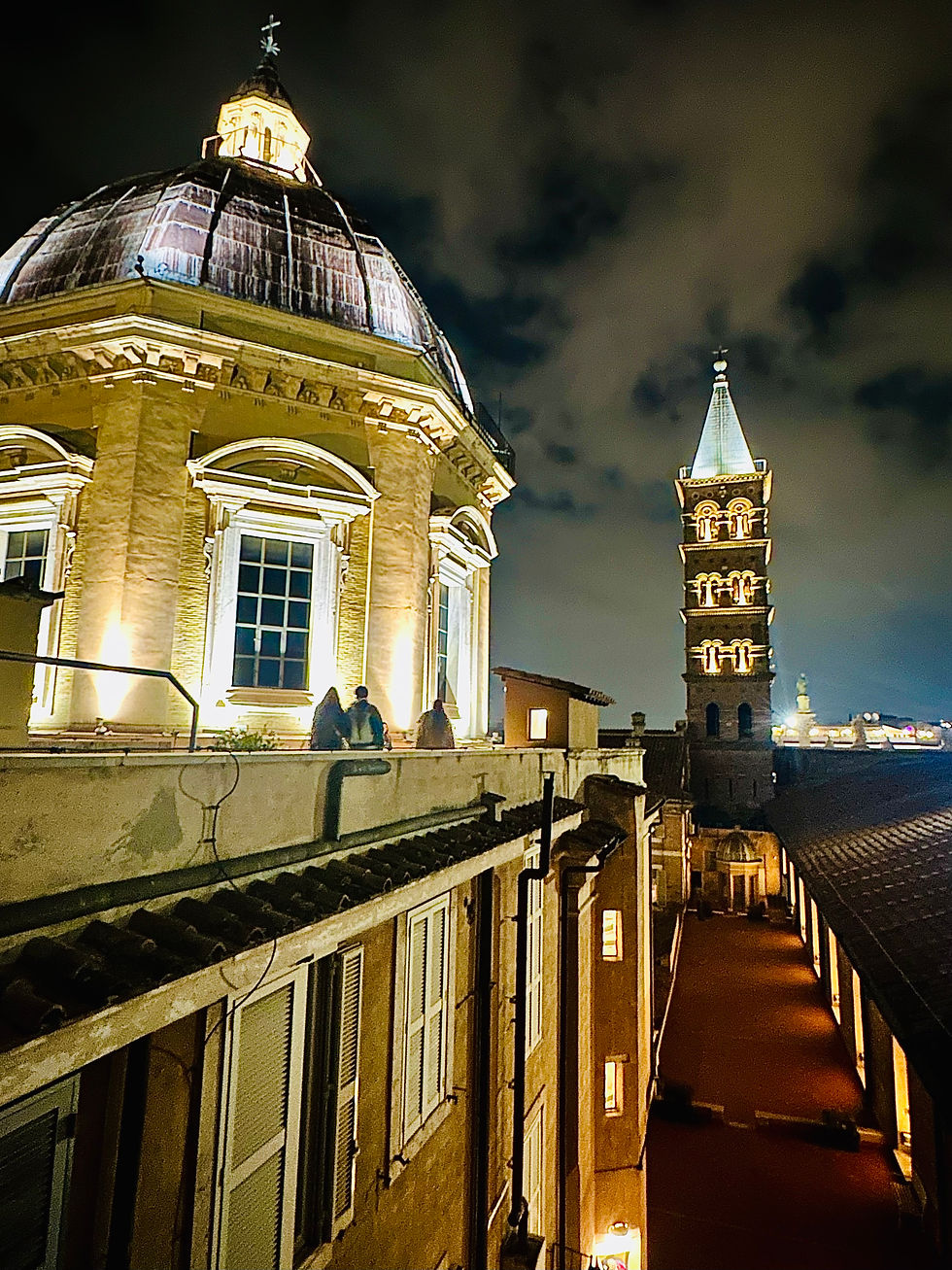
Meanwhile, a security team is making a thorough effort on the pavement: the nativity scene is history at this location. It will not reappear until the next, "unholy" year.

3 basilicas, 3 Holy Doors -
that's all you can do in one day.
The pilgrimage continues.
Happy third Advent!




Comments