

Provocateur and aesthete of photography

Robert Mapplethorpe's "Le Forme della Bellezza" stir emotions at the Museo dell'Ara Pacis in Rome.

A museum-like journey through time into the counterculture
of the 1960s and 70s. Into the urban chaos of New York City—a den of iniquity for some, a creative hotspot for others. Flower Power promoted alternative lifestyles, Black Is Beautiful became the slogan of the Civil Rights Movement, and suffragettes fought for equality. In Brooklyn in 1963, Robert Mapplethorpe enrolled at the Pratt Institute. The 17-year-old high school graduate came from a large, devoutly Catholic family in Queens. He wanted to become an advertising executive, a career that would allow him to earn a living.
At that time, both New York City boroughs were vibrant centers of the American melting pot, ethnically and culturally among the most diverse districts in the USA. The exodus of the white population from these neighborhoods created space for incoming marginalized groups of residents.
Departure into the artistic profession
Robert Mapplethorpe is swept away by the impulses of the US counterculture. His bourgeois origins fade away. He quickly changes his major, making design, painting, and sculpture his ambitions.

Soon he meets Patti Smith, punk and rock musician, photographer, and painter. She becomes his lover, companion, mother, sister, and best friend all in one. His first muse. The couple settles in Manhattan, frequenting trendy clubs with avant-garde artists.
Mapplethorpe expands his sexual orientation, experimenting with African-American men and BDSM practices in underground gay clubs . Free self-expression in an extravagant lifestyle as well as in artistic creation – this has been Mapplethorpe's driving force since the early 1970s.
He finds his models through his diverse encounters. He makes photography his passion as an artistic medium.
Collages
Initially, he experiments with a Polaroid camera, taking everyday shots for everyone. His early collages of religious fetishes and erotic motifs visually demonstrate his enjoyment of material composition.
Body images
At 30, Mapplethorpe uses the then-latest technology of a fully mechanical Hasselblad 500C for his fotographs, whether full-body, portrait, or fragmentary shots. His photographic eye becomes increasingly refined. With the eye of a sculptor for body form and composition, the photographic artist seeks to reveal the essence, the individuality, of a person behind their physical facade.
Muse Patti Smith
Muse Lisa Lyon, first female bodybuilding world champion
VIPs in the movies, literature, painting and sports
Richard Gere, Truman Capote, Roy Lichtenstein, David Hockney, Andy Warhol
Kim Novak, Paloma Picasso
Grace Jones, Isabella Rossellini
Marble and celluloid
Mapplethorpe has enjoyed the reputation of a genio ribelle (rebellious genius) both during his lifetime and posthumously. This is primarily due to his nude photographs, the public reception of which oscillate between innovative, daring, and scandalous.
His provocative photography strikes me as erotic aesthetics. Sublimated. Not a display of sensual flesh. The photographer certainly masters the balancing act on the fine line between art and pornography.
His artful photographs of individuals depict male and female nudes in frozen erotic situations, not in the act of love. Explicit sexual details are omitted, veiled, covered, or relegated to the shadows of the camera's exposure.
Even flowers receive an aesthetic enhancement through Mapplethorpe's camera eye.

Or they serve him as a symbolic female counterpart in the erotic fantasy game between the sexes. Like here, the white calla lilies with their funnel-shaped flower opening, which an African American man in his birthday suit holds almost reverently- in his hands - and with an expectant look in his eyes.

In Rome, the photographer encounters the city's ancient cultural heritage. The marble sculptures of antiquity stimulate him to create an antique-inspired body cult through the medium of photography.
At the same time, Mapplethorpe creates an artistic interplay: He stylizes real bodies into statues in the ancient style, while placing lifeless ancient sculptures in a living environment.

The curators of the Mapplethorpe exhibition in Rome acknowledge the artist's concept. In a dedicated room, his celluloid renderings of sculptures enter into a dialogue with analogous antique marble statues.

This vividly transforms the museum into a space where the past speaks to us today. Beauty in art is revealed here in its continuity and mutability. Mapplethorpe deserves credit for having expanded and redefined the boundaries of visual art.
Up to the top of the art market
Mapplethorpe knew how to gain publicity and market his work early on. His first small private exhibitions were followed by high-profile museum projects in New York, San Francisco, and Venice. At that time, erotic depictions in modern art were still subject to curatorial censorship. Some photographs deemed morally objectionable were banned from exhibition spaces, or underage visitors were denied entry. With Documenta 6 in Kassel, Germany, a globally leading institution for contemporary art, the photographer achieved his international breakthrough in 1977.
The photographer sought recognition in the art world while simultaneously promoting the glorification of physicality, even to the point of undisguised eroticism. He provocatively broke with traditional concepts. In Lisa Lyon, I perceive that he accentuates her androgynous beauty, harmonizing femininity with masculine musculature. His female nudes are devoid of any lascivious allure for male desire. Sexual orientation is broadened through the classically depicted, alluring nudity of African American men.
Mapplethorpe masters an artistic balancing act like no other. His monochrome compositions and deliberately chosen details prevent a voyeuristic view of nudity, softening sexual motifs that could be considered scandalous. The aesthete in him reins in the provocateur.
Photographic logbook

Death comes early. Robert Mapplethorpe dies in 1989 at just 42 years from HIV-related complications stemming from his liberal lifestyle. At that time, AIDS patients had a maximum survival time of only two years.
The photographer created a photo diary of his short but intense life in good time. His self-portraits range from early shots of a rebellious young man with a defiant gaze and tousled hair à la James Dean to his exhausted figure holding a walking stick with a skull-shaped knob as a somber finale.
Even after his untimely death, his success story has continued unbroken. An exhibition at the Whitney Museum of American Art in New York kicked off the series of retrospectives that continues worldwide to this day, currently on display in Rome. Robert Mapplethorpe is celebrated as an exceptional talent in his photographic field, for his commitment to a freely creative artistic space, uncensored and unprejudiced. A mystique of immortality surrounds the young, deceased genius.
"Le Forme della Bellezza" in the Eternal City

No exhibition venue seems more suitable for Mapplethorpe's photografic art than the Museo dell'Ara Pacis Augustae. The marble altar, which celebrated the long-awaited peace in the Roman Empire under the victorious Emperor Augustus, is a permanent exhibit and gives its name to the Roman museum.
Built in 13 BC, the monument was excavated from the mud of the Tiber floodplain in the early 20th century and preserved under a glass container on the banks of the Tiber from 1938 onwards. The glass building of the Ara Pacis Museum was erected on the same site in 2006.
Strict regularity, symmetry, and harmonious proportions are considered by art historians to be hallmarks of classical architecture and sculpture. The ancient Peace Altar is a vivid example.
Mapplethorpe's photographs follow similar design principles. From my somewhat dusty German studies background, a term coined by the German archaeologist Johann Joachim Winckelmann (1717-1768) spontaneously resurfaces, which he used to describe ancient Greek masterpieces: "noble simplicity, quiet grandeur." Does this ideal of antiquity, as a counterpoint to the playful and opulent splendor of the Baroque, also apply to a modern photographic artist like Mapplethorpe?
Yes, indeed: The omission of sexually explicit forms (even the phallic photographs appear detached from sexual innuendo due to strange accessories),
"Man in Polyester Suit"
the rejection of garish, multicolored imagery in favor of monochrome simplicity, the focus on selected body parts and postures, the reduction to the essence of a personality – Robert Mapplethorpe's aesthetic "noble simplicity" has a "quiet grandeur" in its effect. On me.
Opening and closing

For our event, Federico Palmieri, Consule at InterNations, hired an art expert: Gianni Pinnizzotto , photojournalist, Director of the School of Photography and President of the Graffiti Association . He keeps us thoroughly entertained for 40 minutes with his skill, passion and expertise in the shadow of the museum entrance.

Then he sends us off, prepared for our own museum visit, and keeps reappearing entertainingly at our side.
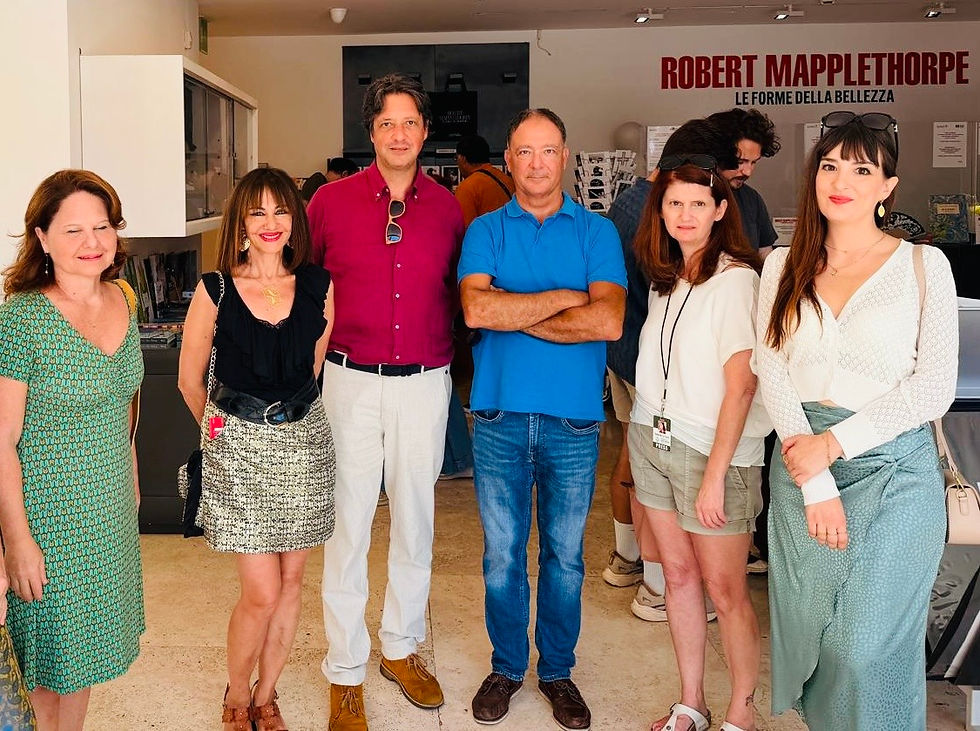
Enjoying art whets the appetite for other fare. No InterNations event is complete without a convivial finale! This time on the rooftop of a deli near the museum. Over lunch, we are chatting contentedly about portraits, personalities, phalluses, and proportions in Robert Mapplethorpe's gallery of over 200 inspiring photographs.

Robert Mapplethorpe
LE FORME DELLA BELLEZZA
29.05.- 04.10.2026
Lungotevere in Augusta
00186 ROMA Rm


Comments