

Faust kicked out - oh dear!?

At Goethe's house in Rome

Farewell, Goethe?
Once soaring through culinary, physical, and cognitive realms of experience, Goethe's literary figure Faust, along with his eponymous life's work (work in progress: 1772-1831), has long since been, or is currently being, removed from the curricula of German schools. This applies to secondary schools, with their once lofty aspirations for a universal education.
It's not just since the 2026 PISA study, which relegated Germany to 23rd place in global reading competence – a drop of seven places since the 2016 study – that the idea of a watered-down version of Goethe's work has resurfaced in the education sector. Oh, here we go again! For example, in the 1980s, proposals to simplify vocabulary and free verse, essentially serving up a lighter version of Faust for the masses, vanished into the curricular dustbin.
And then there came along a comedy. Not a discipline of the drama king Goethe, but an idea of the movie industry. Apart from its provocative title and its location at a fictional Goethe comprehensive school ,"Fack Ju Göthe" had no connection to the poet. However, in the three-part series (2013-2017), this school movie exuded a particularly humorous and rebellious disrespect for what was perceived as an outdated, classic curriculum. But that was ten years ago. Box office hits, yes, but the message has long since faded. It was light entertainment, after all.
Goethe outdated?
Not so at Goethe's former headquarters in Rome. There, he is preserved in a museum. For over 200 years, the Casa di Goethe, his former residence, had fallen into near oblivion. What has been a rather hidden museum in Rome's rich cultural landscape on the Via del Corso since 1997, once housed the learned and ennobled grandee of German literature, Johann Wolfgang von Goethe, from 1786 to 1788 – with interruptions. Writer's block, an affliction that befell him like other members of the literary profession and had already lingered for ten long years, drew him to "the land where the lemons bloom," on the Grand Tour, the educational journey undertaken by European nobles as well as educated and well-to-do members of the bourgeoisie from the 17th to the 19th centuries.

"Even I in Arcadia," the poet exulted, following in the tradition of his learned predecessors, praising his beloved Rome, meaning "the capital of the world." Although: Caput mundi —Rome had long since ceased to be that.

"The desire to see this country was overripe," he noted in the diary of his Italian Journey , and expected a stress-free writer's paradise.
Soon after his arrival in Rome, the poet let out a relieved sigh, not without a peppery dose of self-confidence: "Only now have I begun to live again and to do justice to my genius."

Today, only the first floor of the Casa di Goethe is dedicated to the memory of the globally renowned German poet laureate. The other floors, all the way up to the rooftop, profit from the prestige and name of the crowned head and generate revenue as high-end guest accommodations.
The narrow facade, nestled among a long row of houses, doesn't catch every tourist's eye. Mine certainly does, especially since Via del Corso is prominently located near Piazza del Popolo, once the gateway for streams of pilgrims.
I hesitate before the doorbell plate from 1872 with the inscription: "In questa casa immaginò e scrisse cose immortali Volfango Goethe". Rome's appreciation for Goethe and the immortal themes he invented and wrote about.
Another attempt to keep our cultural memory alive? To preserve a classic of literay art for posterity? I'm setting off on a journey of discovery. With modest travel expenses: €6 for the ticket.
Goethe, old and venerable

In Goethe's former quarters, original or reconstructed wooden beam and coffered ceilings, as well as stone floors, have been preserved. Portraits and a marble bust of the poet by artists of his time fill several exhibition rooms.


Hundreds of architectural and landscape drawings are attributed to the universal genius Goethe. Some of them hang in the museum.
Early editions of Goethe's works, carefully preserved under glass, are sure to delight any German studies scholar. The library also offers a few antique treasures for tactile enjoyment.
Goethe's modernly furnished study is a bibliophile's haven. All the books are genuine. No fake spines for would-be intellectuals. The majority of the books are secondary works: essays, dissertations, habilitation theses. Privy Councilor Goethe, through his writings, has helped aspiring scholars achieve academic recognition for ages.

All these exhibits are old and venerable. They deserve their place in a museum. But where can less educated minds—I mean curious young people eager for knowledge—find what they're looking for? Are there any initiatives to bring Goethe back to life for the younger generation after almost 200 years since his death?
Goethe reloaded
Yes, there are. In the Casa di Goethe. For visitors with a good nose - and intuition.
Goethe as a painter's model
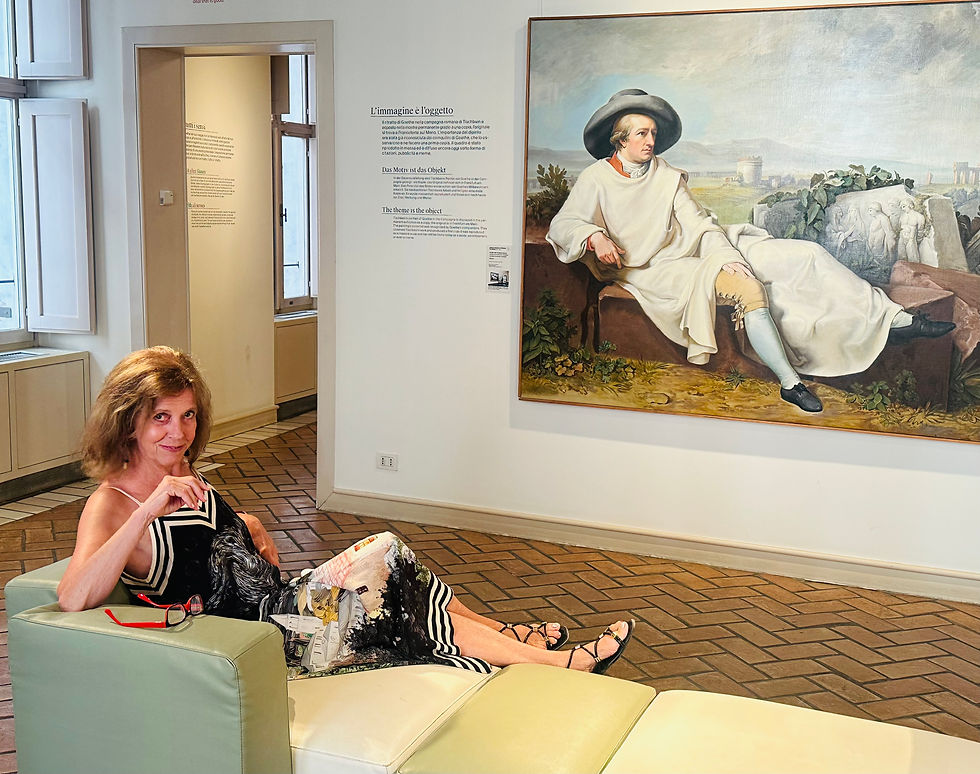
Johann Heinrich Wilhelm Tischbein, the German painter who lived near Goethe, practiced exquisite portraiture before the invention of photography. He depicted the poet laureate realistically and in a manner befitting his social status, in the fashionable traveling attire of a nobleman, reclining on a stately chaise longue against the backdrop of the charming hills of the Campagna di Roma, the Roman countryside. A locus amoenus, an idealized natural landscape imbued with the power of the spiritual Renaissance that Goethe sought on his Italian Journey .
I feel tempted to copy the image. I pose as the feminine counterpart. On the provided modern leather sofa. In the style of an influencer?
Goethe in casual styleTischbein's watercolor "Goethe at the Window" - is a wonderful contrast to the social figure and a perfect template for a comic and its informal caption: "Do you have to gawk out of the window all day, Johann? You better finish your fucking Faust!"
Goethe as a Pop Art iconIn 1982, Andy Warhol designed an oversized version of Goethe's bust, based on Tischbein's original, as a pop-cultural icon. He then had himself photographed in front of the original in Frankfurt's Städel Museum, using stark black-and-white imagery and rigid body language. This self-presentation became his trademark.
Goethe an advertising medium in the IT age
Would the poet, who spent over 60 years working on his two Faust volumes until his death, have been able to complete his writing more quickly if he had been able to utilize the digital speed of a computer? Could he have marketed himself with a mobile phone, internet access, and messages via email and social media? Would quality newspapers have reported on his Italian journey in real time?
What added value do his calligraphically impressive letters, sent en masse via snail mail, offer to us? Goethe with a travel blog and digitized photos instead of hundreds of diary pages and Tischbein's drawings, as well as his own? This is how literary conversations could begin in the digital age.
Goethe to go
I'm taking a slim volume from the Casa di Goethe home with me. His travel logbook already resides in my Casa a Roma anyway.
As I stroll across the Piazza del Popolo, a young couple beams up at me. Clearly, young people like them might be drawn to the graphic updates in the museum. And themes in Faust like lust for life, wanderlust, the joy of discovery, frustration with the academic system, passionate love and unwanted teenage pregnancy, sex, drugs, and rock 'n' roll —surely those should resonate with young minds, too. But no cheap updates: "Oh, so that's how it was back then!" Rather, a critical examination of traditional lifestyles. From a contemporary perspective.
Faust is outmoded!? Not at all!
Find out for yourselves!
Almost an esoteric appeal these days? Students – not their opportunists – are demonstrating for better teaching materials and practices. The wave of protests from Paris has reached European metropolises, including Rome. A Goethe revival – how fitting these days!


Comments